

Medical marketing is always changing, particularly in this new AI-driven era. The truth is, if your medical web design hasn’t been updated in the last couple of years, you might be missing key opportunities to stand out in both AI-generated answers and search engine results pages. At White Coat Web, we bring you the latest strategies to make the most of your medical website in Houston. Read on to discover 5 present-day practices to catch your patients’ (and AI’s) eye.
5 Practices for Your Medical Web Design to Stand Out in Houston
In Houston, where the healthcare industry drives intense competition (particularly with the world’s largest medical complex in the picture), the medical marketing field reflects that competitiveness. Staying up to date with modern strategies makes all the more sense when thinking about how market pressure and constant marketing updates can affect your website’s visibility.
That’s why the process of making a medical web design involves so much more than just creating an attractive layout. A professional website design company knows that it entails knowing your audience, following the rules, and much more. To help, our marketing resident, Graham Dunlap, brings you these 5 tips to make the most of your medical website design:
- Optimize Your Medical Web Design for AI
- Localize for Houston Market Needs and Nuances
- Follow Compliance and Advertising Rules
- Take Patient Experience Into Account for Your Website
- Rely on E-E-A-T and Trust Signals to Rank Higher
Featured Posts

Medical Web Design: A Modern Guide to Standing Out in Austin
The healthcare industry in Austin is growing, and so is medical marketing. What do these...

Website Design for Medical Practices: 5 Tips for Dallas Doctors in Modern Times
Marketing practices are changing to adapt to current trends, and website design for medical...
Optimize Your Medical Web Design for AI
Artificial intelligence is becoming a part of everyone’s life and has even entered the healthcare industry, with patients using it to navigate health care challenges. This includes understanding diagnosis and treatments, preparing for visits, discovering tips, and so much more.
But for tools like AI Overviews and chatbots to show users the information they ask for, AI-powered engines need to get the answers themselves first. The knowledge behind their answers comes from several sources, with websites being one of them. Therefore, practices that follow modern strategies are more likely to be surfaced by AI tools.
🥼 Discover more about current tactics: 4 ways GEO strengthens your connection with patients in Houston
Localize for Houston Market Needs and Nuances
The Greater Houston area covers a vast, traffic-heavy area, causing many patients to prefer care close to home. Optimizing your website to target specific areas is essential when you’re looking to reach patients who need your care. That way, when they look for “newborn care in The Heights” they will find your practice among their options. See an example with one of our own: HG Pediatrics:
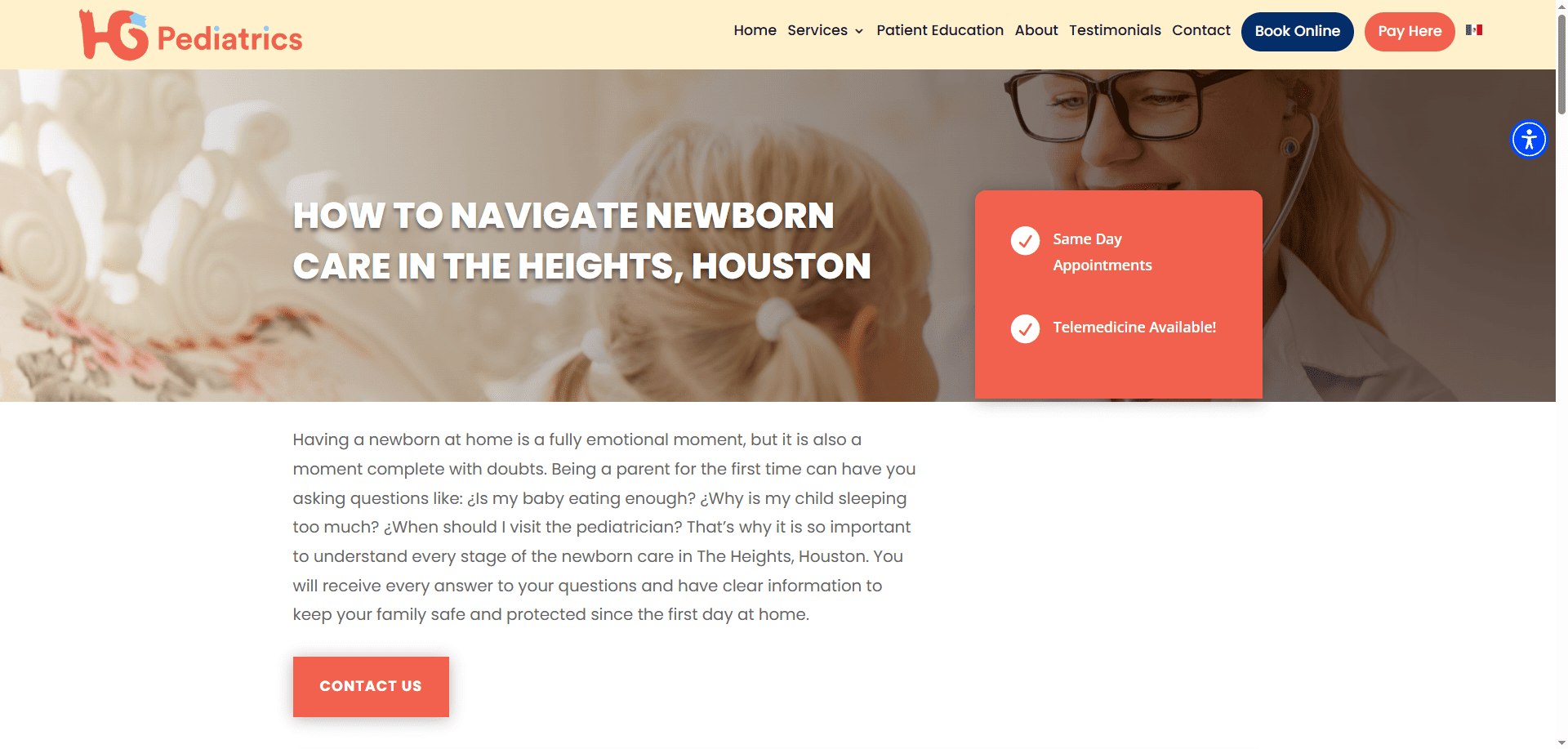
Practices like localization for websites involve more than simply naming areas across your website, with strategies like bilingual marketing also being key to reach more patients. Houston, where 38.38% of residents (around 852,519 people) speak Spanish at home, is one of the areas where medical practices could benefit greatly from this approach.
🥼 Discover The Power of Proximity: Why Localization Matters for Houston Practices
Follow Compliance and Advertising Rules
Rules are everywhere, including medical website design. To gain and protect your patients’ trust, and establish your practice as a reliable health partner, you must follow certain regulations. As a physician you probably already know about HIPAA (Health Insurance Portability and Accountability Act) and ADA (Americans with Disabilities Act).
While both these rules are key, for medical practices promoting their services in Texas, following the Texas Medical Board (TMB) advertising rules is a must. Some requirements for your medical website design in Houston could include:
- Making truthful claims
- Complying with board certification rules
- Providing authentic testimonials and photos
Take Patient Experience Into Account for Your Website
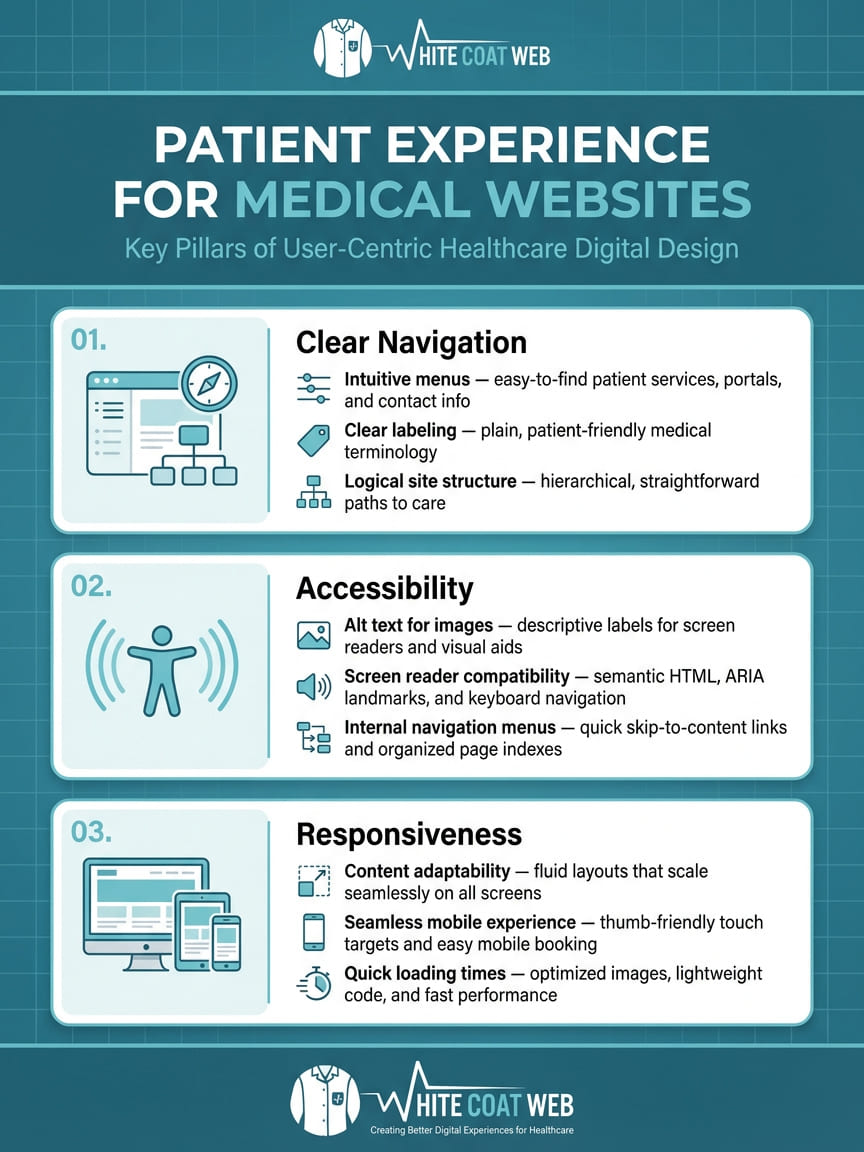
You wouldn’t spend time on a website that’s difficult to navigate, with broken links, and, worst of all, impossible to read on your device, nor would your patients. As soon as users notice something off on a site, they would simply leave it and go to another site. Considering aspects such as clear navigation, accessibility, and responsiveness in your medical web design is essential for engagement and retention purposes.
Rely on E-E-A-T and Trust Signals to Rank Higher
A strong E-E-A-T (experience, expertise, authoritativeness, and trustworthiness) and trust signals incorporated throughout your medical website are going to be a core pillar for ranking higher. Both Google and AI tools rely on standard guidelines to evaluate your website’s reliability and quality. This is of particular importance when it comes to businesses that fall under the YMYL (Your Money or Your Life) category, which includes topics like health and safety.
Some recommendations to withstand the stricter scrutiny your medical website will face and build trust, try:
- Showcasing your expertise, qualifications, and experience
- Highlighting real patient testimonials, reviews, and photos
- Sharing transparent, original, and accurate information
- Relying on trusted citations, references, and backlinks
- Keeping your information up to date
🩺 You Might Be Interested on How to Build Patient Trust Through Smart Medical Advertising
FAQ
Why is mobile responsiveness so important for my web design?
Mobile responsiveness is essential for medical websites nowadays because over 45% of U.S. citizens report using a mobile device to manage their health. This is an important portion of potential patients whom medical websites could be missing out on if not properly optimized.
How often should a medical practice update its website?
A medical practice should update its website as soon as important changes occur, whether they involve new providers, services, treatment options, accepted insurance plans, contact information, or locations.
What makes a medical website optimized for modern search?
A medical web design is properly optimized for modern search when it combines E-E-A-T with trust signals, is adjusted for both search engine optimization and generative engine optimization, has a responsive design, follows strategies for local visibility, and complies with rules and regulations.
Ready to Boost Your Medical Website in Houston?
Keeping your medical site up to date with current marketing trends can be a demanding task, particularly if you’re not familiar with them. Fortunately, a medical web design company can help you keep your website competitive in Houston. Contact us at White Coat Web to boost your online presence with present-day strategies.

Willie White Coat, AKA Graham Dunlap
Graham is a digital strategist with 10+ years of experience leading marketing teams. As the co-founder of White Coat Web, he focuses on modern SEO/GEO and digital growth, helping medical practices expand their online visibility and revenue while adapting to continuously evolving industry techniques.
In his words, “We’re passionate about people, so you can be passionate about your patients.”