
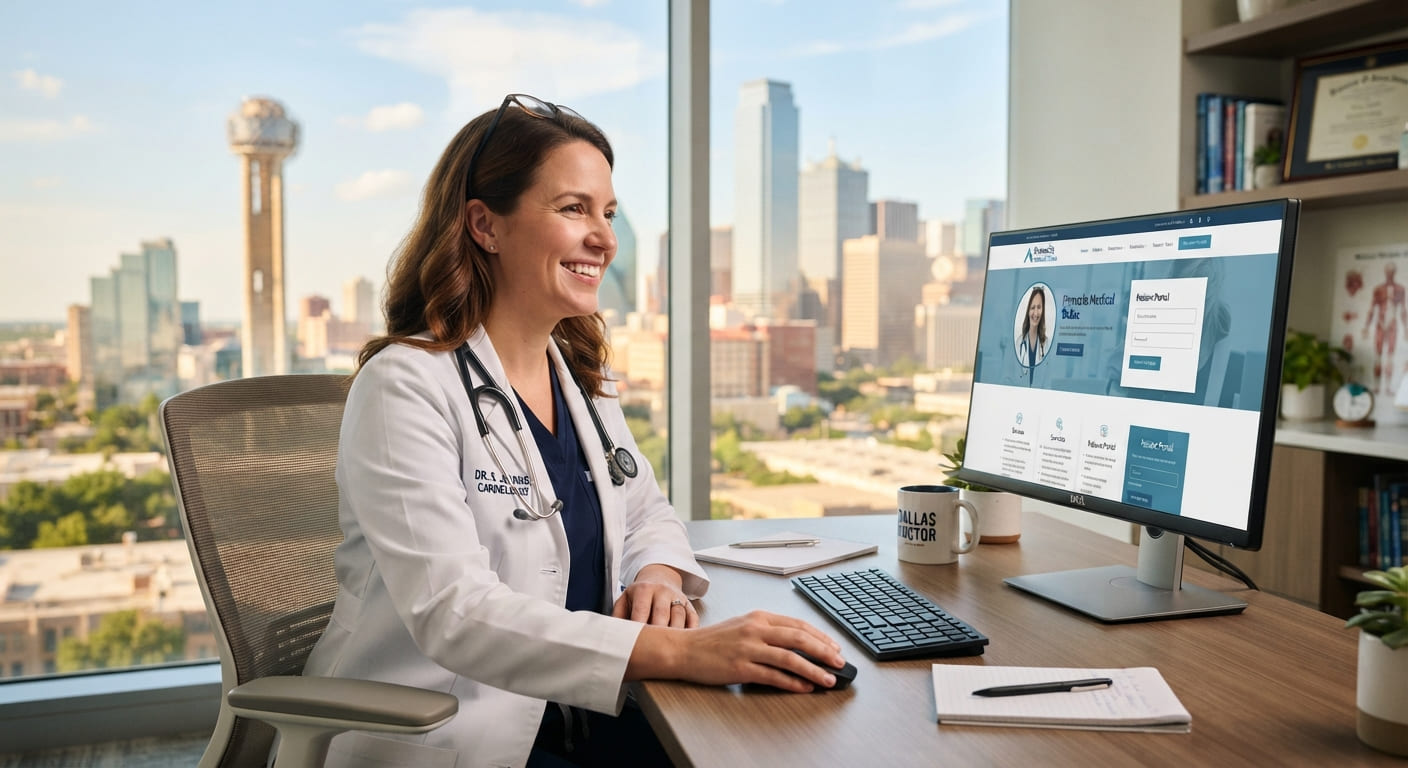
Marketing practices are changing to adapt to current trends, and website design for medical practices is no exception. With artificial intelligence (AI) entering the picture, competition evolving constantly, and search behavior changing, staying up to date with current strategies becomes key if you want to stay ahead of the curve. Read on to discover 5 tips for your website to succeed during these modern times in Dallas.
Website Design for Medical Practices in the Era of Artificial Intelligence
AI is changing the way patients find doctors and medical practices. Nowadays more and more people are turning to tools like ChatGPT or AI Overviews to compare practices, look for doctors near them, and ask the questions that would lead them to you.
But where do those AI-generated answers get the information? The truth is that the information doesn’t come from a single source, but from several, with your website being one of them. However, for your name to be featured in potential patients’ answers, your website needs to be properly optimized. This is where modern website design for medical practices comes into play.
5 Tips for Your Website to Succeed in Modern Times in Dallas
Staying relevant in a competitive market can be one of the most challenging tasks in the medical industry. Fortunately, here are a few practical tips to stay competitive:
- Work On Building and Maintaining Your Trust Signals
- Build Up a Responsive Website Design for Medical Practices
- Rely on Strategic Localization Practices
- Embrace Dallas Diversity With a Bilingual Approach
- Trust in Informative and Engaging Medical Content
Featured Posts

Medical Web Design: A Modern Guide to Standing Out in Austin
The healthcare industry in Austin is growing, and so is medical marketing. What do these...

Medical Web Design: 5 Present-Day Practices for Houston Doctors
Medical marketing is always changing, particularly in this new AI-driven era. The truth is, if...
Work on Building and Maintaining Your Trust Signals
Trust signals not only build credibility and reinforce your expertise in the eyes of patients, but also help AI tools and search engines to determine whether your website is safe to recommend. There are several markers that are evaluated to assess your reliability, with some of the strongest trust signals being:
- Demonstrating your experience, expertise, and qualifications
- Creating accurate, transparent, and original content
- Keeping your information up to date
- Having strong website security
- Using reliable citations
👉 Proving and maintaining your credibility takes ongoing effort, but AI systems and search engines are more likely to surface content that appears credible.
Build a Responsive Website Design for Medical Practices
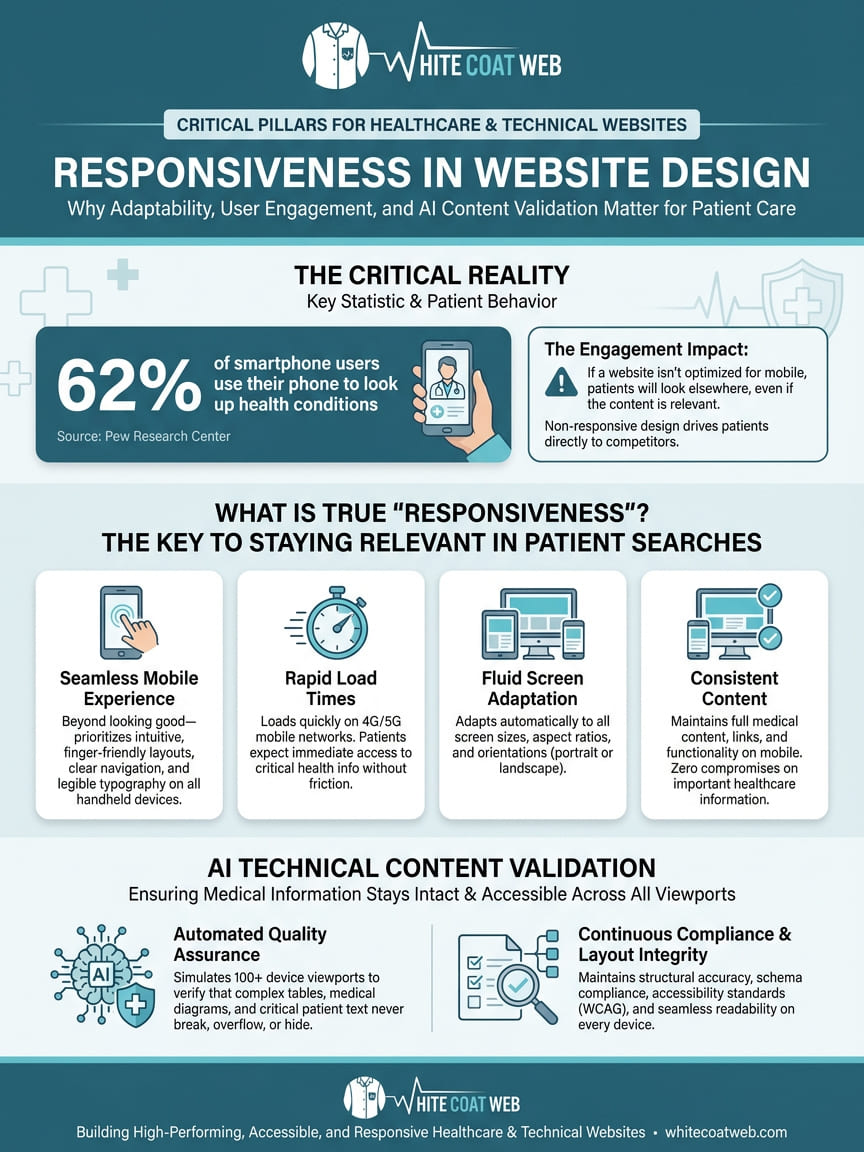
According to Pew Research Center roughly 62% of smartphone users have used their phone to get information about a health condition. Some smartphone users will probably end up on your website. However, even if the information is of interest to them, if your website is not optimized for their channel they are likely to look for what they need elsewhere.
A key to staying relevant in your patients’ searches is responsiveness, which is about having a website design that prioritizes a seamless mobile experience. This is about more than a website that simply looks good on a phone or a tablet. It is about a design that loads quickly, adapts to different screen sizes and orientations, and maintains consistent content across devices.
Rely on Strategic Localization Practices
If your goal is to reach more patients in Dallas, strategies like localization are essential for your practice. With a strategy like this, instead of aiming for the whole metropolitan area, you will focus on the specific locations where your patients are and need you. That way, when they look for a “doctor near me” they can find your practice more easily. Some of the key aspects that are likely to support AI and guide patients to you include:
- Localized landing pages
- Transcreated content over literal translation
- Optimized Google Business Profile (GBP)
- Consistent NAP (name, address, and phone number)
🥼 Learn more about Localization Strategies to Stay On Top of the Game in Dallas
Embrace Dallas Diversity With a Bilingual Approach
Dallas is home to one of the largest Hispanic communities in Texas, with 42.6% of residents being of Hispanic or Latino origin, and 34.9% speaking Spanish at home. This is a large portion of the population that requires healthcare and could face barriers to accessing it due to their language.
Medical practices that look to reach this audience could benefit from integrating bilingual solutions into their website design. This way, patients would be able to find them not only through search engines like Google, but also through AI tools like chatbots when searching in their language.
Trust in Informative and Engaging Medical Content
Incorporating content that is both engaging and informative in your medical website is a great way to connect with patients and build trust, but it is also key to appearing in their searches. As we mentioned before, AI surfaces information found through various sources, including websites. Doctors can leverage this feature to appear in generated answers, using their content as a bridge between patients and search tools like AI-powered search engines.
📺 Watch our 3-minute webisode on How SEO Drives Organic Conversions
FAQ
What makes a medical website optimized for modern search?
A modern website design for medical practices combines a patient-first approach focused on clear, structured, and accessible content that helps build trust and credibility with specialized pages for services and localization practices.
What essential pages does a medical practice website need?
A homepage, a provider or about page, individual service pages (conditions and treatments), and a contact page are some of the must-have for every medical website.
Is my medical website required to comply with HIPAA?
It depends: if your medical website collects, stores, or transmits Protected Health Information (PHI) through forms,portals, or similar tools, it must comply with HIPAA. A purely informational page with no patient data is generally lower risk.
Let Your Website Be One Step Ahead in the AI Era
Keeping pace with marketing changes takes time, especially when managing website design for medical practices. Contrary to what its name might imply, this process involves more than just the online image of your practice. Technical aspects, language, and specialized pages are also essential for the site’s functionality. If you’re looking for a website design agency in Dallas to manage these details for you, White Coat Web can help.

Willie White Coat, AKA Graham Dunlap
Graham is a digital strategist with 10+ years of experience leading marketing teams. As the co-founder of White Coat Web, he focuses on modern SEO/GEO and digital growth, helping medical practices expand their online visibility and revenue while adapting to continuously evolving industry techniques.
In his words, “We’re passionate about people, so you can be passionate about your patients.”