

The healthcare industry in Austin is growing, and so is medical marketing. What do these industries have in common? Both impact your visibility and competitiveness. In an era where being online equals having a social presence, it’s not surprising to find that the digital field can be as competitive as the offline world. A practice’s site serves as an online front desk, making a present-day medical web design essential to stand out from the crowd. If you’re looking to make the most of your online domain, White Coat Web brings you a modern guide. Read on.
Why Is Having an Updated Website Essential for Austin Practices?
People often turn to search engines and answer tools often to find doctors, services, and treatments in their area. For your medical website to appear among their answers, it is essential to stay up to date with current practices. Moreover, this approach can help you avoid getting lost in a sea of competitors who are already employing the latest marketing techniques.
Adapting to current strategies is particularly important in Austin, where modern patients rely on online convenience, search traffic is mobile-first, and the younger demographic expects a seamless digital experience.
Essentials for a Modern Medical Web Design
Website design covers more than a pretty layout and an online domain with your practice’s name on it. It encompasses key aspects like user experience, clear navigation, indexing, and much more. Some essentials for making sure your medical web design keeps up with the times include:
- Generative engine optimization (GEO)
- Content structured for artificial intelligence (AI)-powered tools
- Responsive and accessible design
- Fictionless calls to action (CTAs)
- Intuitive and clear navigation
📺 Watch this short webisode on Key Elements to Consider When Building a Website
Featured Posts

Medical Web Design: 5 Present-Day Practices for Houston Doctors
Medical marketing is always changing, particularly in this new AI-driven era. The truth is, if...

Website Design for Medical Practices: 5 Tips for Dallas Doctors in Modern Times
Marketing practices are changing to adapt to current trends, and website design for medical...
4 Strategies to Make Your Medical Web Design Stand Out Today
With the rise of AI and its influence on consumer behavior, it is only natural to see a shift in current digital marketing practices. For instance, people’s online questions are getting longer, more conversational, and more specific, making practices like keyword stuffing and quantity over quality do more harm than good. Some effective strategies for medical web design include:
- Prioritize a Responsive and Easy-to-Navigate Design
- Highlight Expertise and Trust Signals
- Let Patients Know How and Where You Can Help
- Talk the Language Your Patients Speak in Austin
Prioritize a Responsive and Easy-to-Navigate Design
The adoption of mobile devices for web browsing is a trend that only continues to grow. According to a global overview by DataReportal, approximately 5.86 billion (70.4% of the world’s population) are mobile phone subscribers.
But navigating on mobile devices is significantly different from doing so on a desktop. That’s why a modern medical web design requires prioritizing navigation and responsiveness with practices such as:
- Adapting layouts to fit different screen sizes
- Making the design intuitive and easy to understand
- Establishing visual and messaging hierarchies throughout
- Scaling text and media to be readable on different screens
🩺 Find Out More About Responsive Website for Doctors
Highlight Expertise and Trust Signals
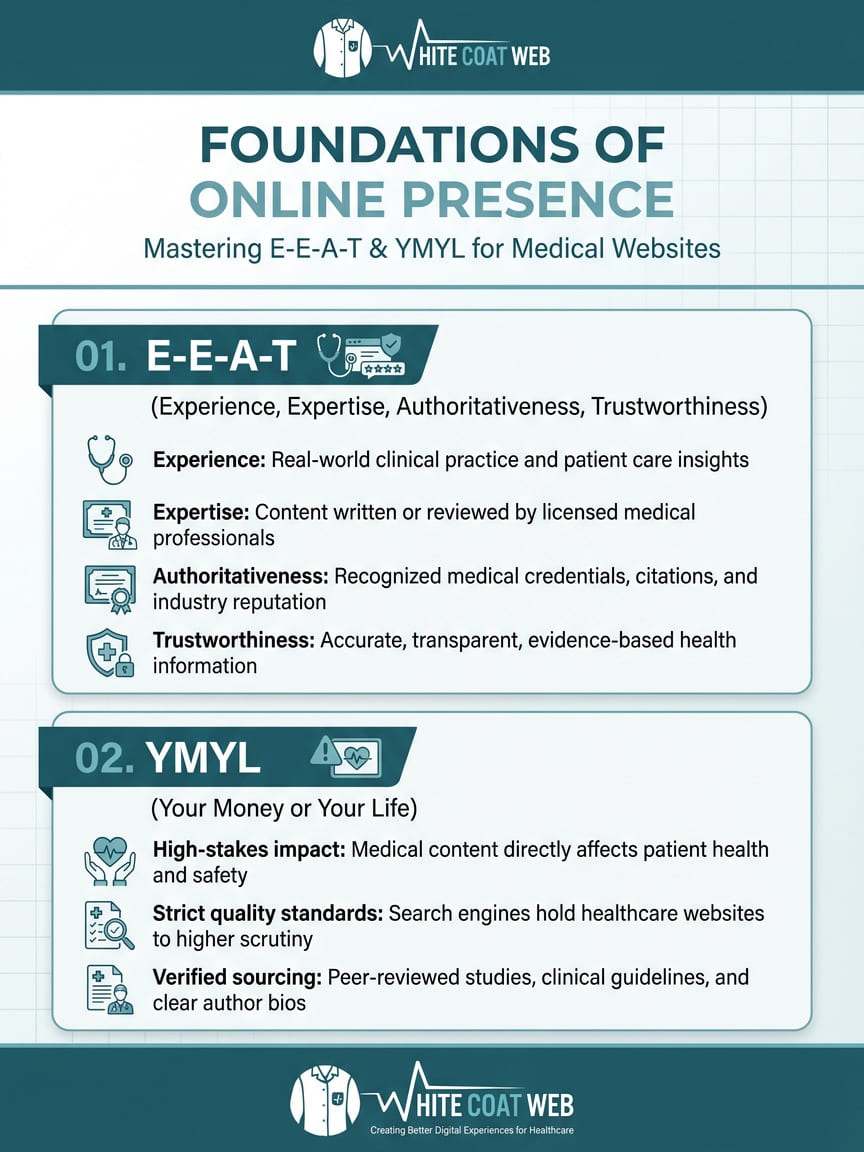
When it comes to medical websites, displaying the providers’ expertise, qualifications, and experience is critical. This has become one of the foundations of credibility and reliability, not only for humans but also for AI. Nowadays, your medical web design has to impress not only people but also large language models (LLMs) too, since these technologies increasingly provide potential patients with answers.
Let Patients Know How and Where You Can Help
When people go to search engines or answer tools looking for answers, or recommendations, or comparing practices, they often include naming locations, treatments, symptoms, and specialties in their queries. Instead of keyword stuffing, strategically placing the words your patients use strategically can make all the difference. This includes prioritizing commercial and funnel-oriented keywords and targeting long-tail and question-based keywords.
Having dedicated pages for services, specialties, treatments, and contact information that mention your practice’s location is an effective way to help LLMs understand your practice. Doing this provides AI-powered tools and search engines with the answers people need, right from your website.
🥼 Discover 3 Effective Localization Tips For Medical Practices in Austin
Talk the Language Your Patients Speak in Austin
On the subject of including your patients’ keywords strategically throughout your website, there’s the matter of speaking the same language they do. Patients are not looking for terms like “dyspnea” or “myocardial infarction”, but instead they search for “shortness of breath” or “heart attack.” These are the words your medical website should include to be found by people looking for you and to connect with them.
Talking the way they speak can also mean writing in other languages, literally. If your practice is aiming to show up for people who search in Spanish, you will probably benefit from having a bilingual website. However, be careful about using translation tools when taking this approach, since the context of the message could be lost and communication with the intended audience affected.
👉 See for yourself how a bilingual site works on the website of Erin Dunlap, MD:


FAQ
What makes a medical website optimized for modern search?
To optimize a medical website for modern search, it is essential to combine trust signals, user intent matching, local visibility, and user experience. This helps your site be found not only by patients but also by search engines and answer tools, which is critically important today.
How often should a medical practice update its website?
Your practice’s website should be updated each time important information changes. This includes contact or location information, providers, treatment options, and conditions treated.
Should my medical website comply with any regulations?
Yes, medical websites must comply with regulations such as Americans with Disabilities Act (ADA), Health Insurance Portability and Accountability Act (HIPAA), and security and privacy rules. Additionally, medical websites in Austin, Texas, should follow the Texas Medical Board advertisement rules.
Ready for Your Website to Stand Out in Austin?
Keeping up to date with medical marketing changes can pose a challenge, particularly during this AI-driven era, when these innovations are moving fast. If you have an outdated medical web design or are looking to launch a domain of your own, finding a website design company that is already up to date with these developments can make a significant difference. Contact us at White Coat Web to partner with a team of experts that will help you bring your site to the next level.

Willie White Coat, AKA Graham Dunlap
Graham is a digital strategist with 10+ years of experience leading marketing teams. As the co-founder of White Coat Web, he focuses on modern SEO/GEO and digital growth, helping medical practices expand their online visibility and revenue while adapting to continuously evolving industry techniques.
In his words, “We’re passionate about people, so you can be passionate about your patients.”