

With every innovation, comes an opportunity—now, how to keep up with it? That is the question. With the meteoric rise of AI-fueled everything, ChatGPT might as well stand for “Chat General Physician Temp”: patients are turning to it for just about anything medical. From looking up symptoms to finding a doctor in their area, they are relying on the results that AI produces—and GEO is what can get you there. At White Coat Web, we are breaking down what GEO for healthcare is and how your practice can harness it to benefit both you and your patients.
What Is GEO for Healthcare?
GEO is SEO’s sibling. What does this mean? Well, SEO stands for “search engine optimization” and it means preparing content so that it can rank well in search engines. As its AI complement, GEO means “Generative engine optimization,” and it refers to producing content in a way that AI engines will pick it up and show it to users.
Engines like ChatGPT, Gemini, Copilot, or even Google’s AI overviews get their information from what they find online. Subsequently, they share this information with patients when they search for queries related to your services or areas of expertise. Because of that, the content that you create for your site has the potential to be featured in AI’s results—and in front of your prospective patients’ eyes.
The overtake of AI is undeniable, and when it comes to healthcare, there is generalized anxiety surrounding doctor-patient relationships; however, this presents an opportunity for healthcare providers to reach patients directly and improve the three-way clinical dynamic (patient – AI – doctor). If you implement GEO for your healthcare content, your authoritative voice can resonate through AI engines and offer reliable information to patients. Just like SEO puts your content in front of your patients on search engines like Google; GEO can ensure your expertise surfaces when patients ask AI assistants for medical guidance.
🥼 Read more: How Medical SEO Connects With Your Patients: Your Online Front Desk.
So, Does This Mean SEO No More?
GEO is an added layer to your practice’s visibility / optimization strategy, which starts with SEO. So, in short, no. Both share the ultimate goal and the methodology.
Here Is why SEO Still (Very Much) Matters
Your comprehensive digital marketing plan’s objective is to enhance the visibility of your practice by creating relevant content that leads patients to you.
As for the methodology, GEO and SEO are built on the same keyword strategy, user experience and intent, quality of content, metrics, technical optimization, authority, and flexibility to adapt.
While there are nuances in the way to approach content creation for both engines, overall, SEO continues to provide the basis for the methodology. This means:
- Continuing to conduct pertinent keyword research based on patient intent.
- Keeping your site technically sound (fat-loading times, mobile-friendliness, accessibility, clear sitemap, etc.)
- Leveraging metrics both for search engines and generative engines.
🥼 Put on your digital white coat: Online Visibility for Physicians: An Essential Guide to Boost Your Digital Presence
3 Ways Healthcare Providers Can Harness GEO
1. FAQ Your Way into AI’s Heart
AI engines respond to natural language queries, so your content should mirror how patients actually ask questions. Apart from targeting keywords like “dentist in Brooklyn,” create content that answers specific questions like “What are the warning signs of heart disease?” or “When should I see a cardiologist for chest pain?” An FAQ section is essential in this era where answers are at our fingertips.
Structure your content with clear headings in question format (H2s and H3s), provide direct, concise answers at the beginning of each section, and then expand with detailed explanations. This format helps AI engines extract and cite your content when patients ask similar questions.
2. Become an Authority Machine
AI engines prioritize credible, authoritative sources—especially for medical content where accuracy is critical. Strengthen your practice’s authority signals by:
- Publishing original content based on research, case studies, or clinical insights.
- Highlighting your credentials, board certifications, and specialized training
Prominently.
- Earning citations and backlinks from reputable medical institutions and publications.
- Maintaining active profiles on medical directories and review platforms.
- Creating educational content that demonstrates depth of expertise in your specialty.
The more AI engines recognize you as a trusted medical authority, the more likely they are to reference your practice when patients seek information or provider recommendations.
🎞 Watch our 3-minute webisode: What Does It Mean to Be an Authority Machine?
3. Be the One to Quote
AI engines need to understand your content. Make your information easy for AI to parse and cite by implementing the strategies mentioned above and:
- Including information about your practice’s providers and their credentials on your site.
- Writing in a way so clear that AI can extract it and quote it directly.
When your content is well-structured and properly marked up, AI engines can confidently pull accurate information about your practice and present it to patients searching for care.
Looking to Harness GEO for your Medical Practice?
As stated above, GEO is not about replacing SEO, it’s about complementing it. It’s about joining patients on their journey, which now includes AI searches. When you optimize your content, you are ensuring that your practice stays relevant, visible, and accessible across platforms.
If you are looking to optimize your practice and open a new chapter in your trajectory, at White Coat Web we are here to help. We specialize in helping healthcare providers help others. Our dedicated team can create content that puts your practice not only on the map, but on the generative realm.
FAQ
How does GEO work?
GEO works very similarly to SEO, feeding AI engines relevant information that patients are looking for. If the content written includes the features mentioned in the article, it has more chances of being featured by AI in its results.
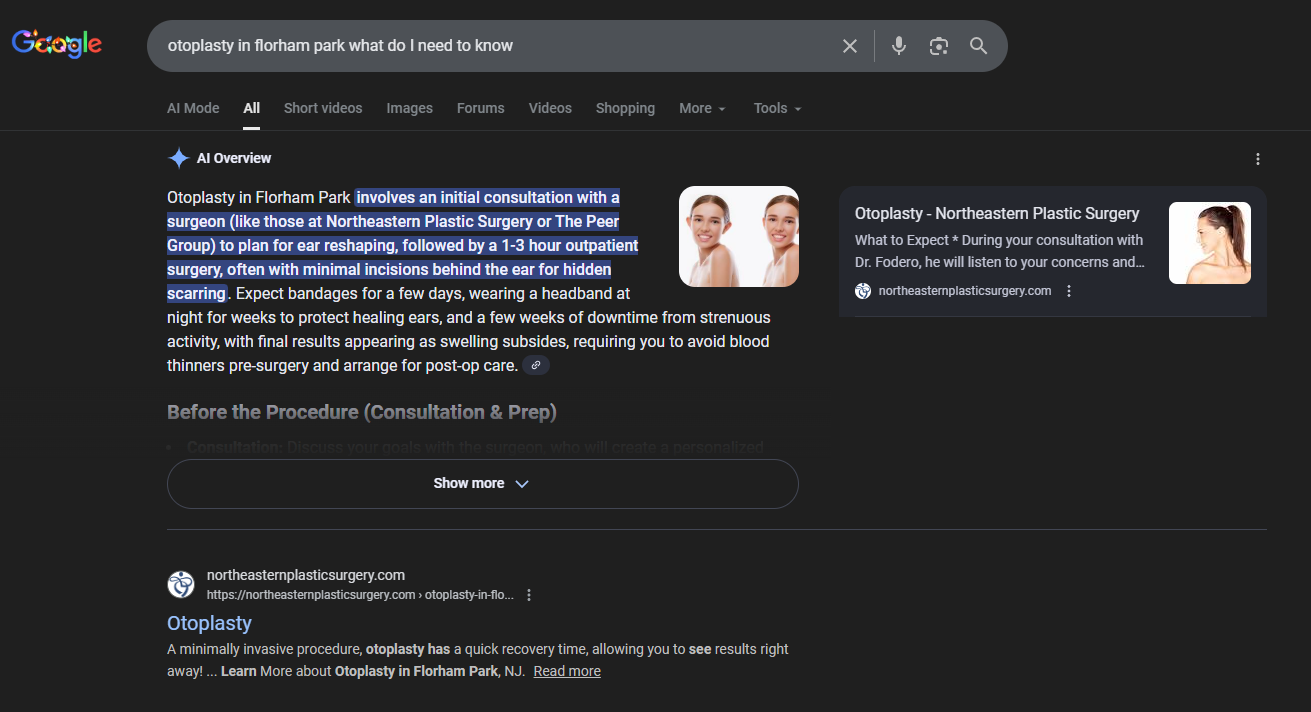
So, for example, if a patient is curious about getting an otoplasty in New Jersey and type the query into Google, Google will automatically reproduce content written by a trustworthy source like Northeastern Plastic Surgery.
Will patients still visit my website if AI gives them answers directly?
Yes. While AI provides quick answers, patients seeking care still need to take action—schedule appointments, verify credentials, check insurance, and establish trust. AI-generated responses often include citations and links to sources, directing patients to your website for more detailed information and to connect with your practice. Being featured in AI responses actually increases your credibility and drives qualified traffic.
How long does it take to see results from GEO?
Similar to SEO, GEO is a long-term strategy. You may start seeing your content referenced by AI engines within a few weeks to months, depending on your existing authority, content quality, and optimization efforts. Consistent publication of high-quality, authoritative medical content accelerates results. Monitor mentions in AI platforms and track referral traffic to gauge effectiveness.
Is GEO safe for healthcare providers given HIPAA and medical regulations?
GEO is indeed safe because it doesn’t share patient information—it focuses on optimizing your educational content, credentials, and practice information that’s already public. You’re simply making your existing website content more accessible to AI engines. Always follow HIPAA guidelines, avoid patient-specific information, and ensure all published content complies with medical advertising regulations in your jurisdiction.