

Website design for medical practices in Houston has changed a great deal in recent years, driven by AI-generated content and the use of AI to design web pages. In a market as competitive as Houston’s medical pool, this raises an obvious question: how do you stand out in a city where thousands of doctors rely on AI templates? At White Coat Web, we’re clear on this: AI should enhance creativity, not limit it. In this article,our team explains how AI Slop is taking over web design and how this could be your opportunity to stand out from your competition.
The Houston Web Design Conflict: Clone Wars
Picture a mom in Katy scrolling through clinics on her phone at 10 p.m. while her toddler finally sleeps. Two of the pediatric websites look almost identical: the same smiling stock doctor, the same “compassionate care” headline, the same tidy blue/purple layout. AI tools built both of them in an afternoon, and she can tell.
AI is a fast assistant that can sketch a layout and draft a homepage before your coffee gets cold. The catch is in how it works. As Google’s own guidance on generative AI content explains, “These models work by predicting the most likely sequence of words”. So when using AI, you get the most likely website, which is also the most average one.
Let’s say something controversial here (please don’t cancel us): average is the antithesis of good marketing. And being average in Houston, which is home to the Texas Medical Center, is not a good idea. That average look carries real costs since patients here have endless choices, and they compare you with all of them.
🔍 Read More About Our Website Design Services
Common Symptoms of an AI-Built Site
A site with a little rough charm still feels like it was made by real people, and patients can read that. A generic one doesn’t give them anything to read. If your homepage could belong to any clinic in Houston, a patient who compared three practices tonight won’t remember which one was yours.
The design isn’t bad. It’s anonymous, and an anonymous site quietly says nobody on your team made a single choice.
You’d expect this to get better as the tools improve. But, in fact, it is quite the opposite. AI models learn from the web, and the web is filling up with AI-built sites. When a look catches on, it can end up in the next round of training data and look even more “normal” to the model. A style that felt fresh last year becomes the default this year. The window between “distinctive” and “default” keeps getting shorter, so a site that doesn’t make its own choices gets old faster.
🥼 Look at the results of working with a medical website company
Is Your Houston Medical Practice Website Looking Like “AI Slop”?
Here are the giveaways of an “AI slop” website. No single one is a crime. But stack enough of them, and your site starts to read as low effort, which is a risky first impression for a practice. If yours has all of them, it was designed by nobody:
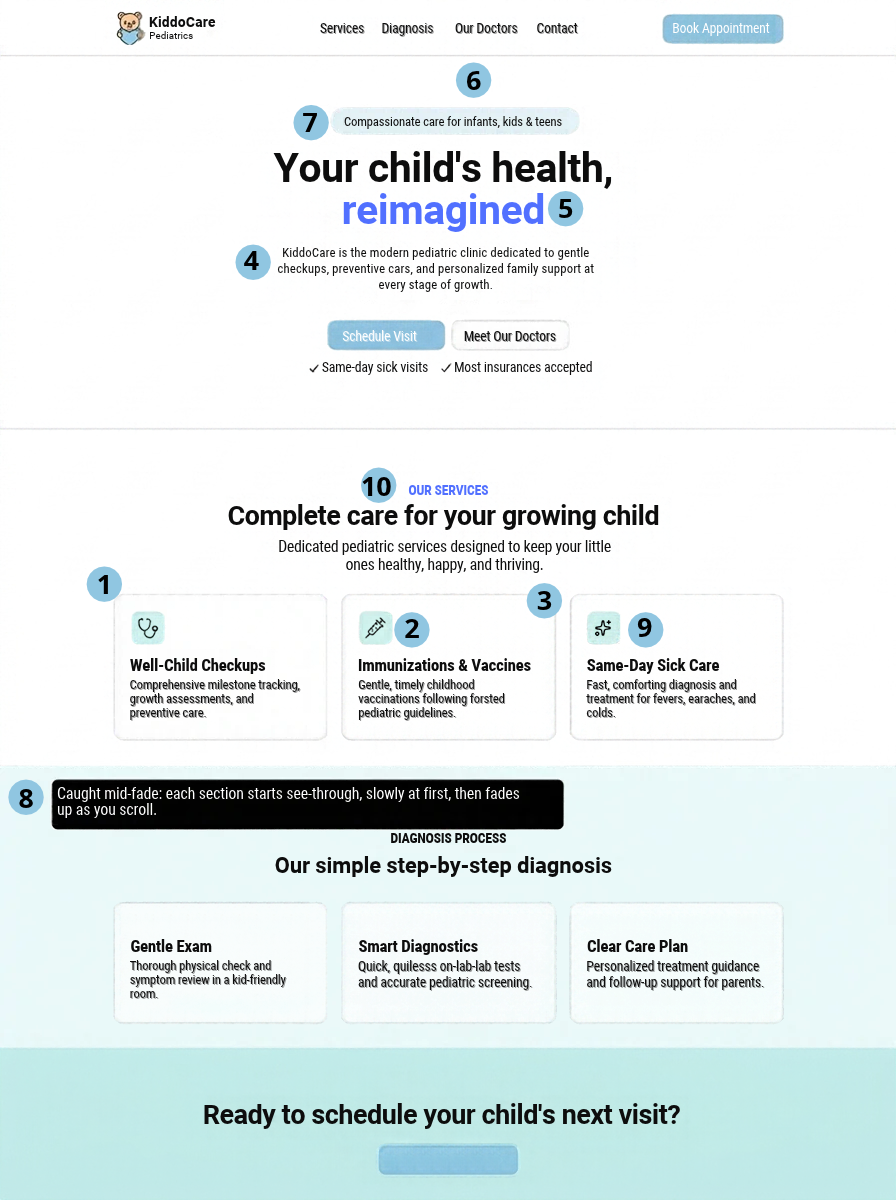
These ten patterns come from a Build to Launch study of 120 AI-built pages. This is a fictional example made with AI to illustrate how “AI Slop” looks and how common those design clichés are.
- Icon cards in a 3- or 4-column grid (63%): services shown as identical rounded cards in a row, so nothing stands out as more important than anything else.
- One icon set only (63%): every icon comes from the same default library (Lucide in the example), so the site shares its visual language with thousands of others.
- Default component colors (61%): the site keeps the template’s color structure (shadcn in the example) and swaps only the main button color.
- No font chosen, or Inter (60%): the typography is whatever the tool picked, not a decision about your brand.
- An accent word in the headline (52%): one word set in a different color (“reimagined” in the example) to add emphasis.
- Centered hero (51%): the headline, subtext, and buttons stacked in the middle, just like everyone else’s homepage.
- A pill badge above the headline (51%): a small rounded tag with a tagline (“Compassionate care for infants, kids & teens” in the example).
- Fade-up on scroll (51%): every section starts see-through and slightly low, then fades in as you scroll, which delays the information the visitor came for.
- “AI” icons: sparkles, zap, brain (47%): symbols that say “technology” instead of anything about the service.
- Small uppercase tracked labels (42%): tiny, widely spaced caps above section titles (“OUR SERVICES” in the example).
Is your website showing symptoms? Our design team can examine your current layout and build a custom treatment plan around your practice, your providers, and your community:
AI Gives You Speed. Human Specialists Give You an Unfair Advantage
Every medical practice has its own bedside manner, and your website’s architecture should reflect it. While AI generators stack pre-made blocks based on statistical averages, our web designers make intentional visual and structural choices that match your brand’s personality and set you apart from every other clinic in Houston.
We can’t unpack every creative decision we make in a single website, as each build depends on our clients’ goals and our specialists’ criteria. However, here is how human-led web design breaks away from “AI Slop”:
Custom Visual Hierarchy Over Identical Grids
AI treats every service equally, dumping them into uniform three-column cards where nothing stands out. A human designer builds a deliberate visual path. We use asymmetric layouts, intentional typography (not just the default Inter font), and tailored color psychology to guide a stressed patient’s eye directly to your core specialties and booking buttons. And instead of sluggish “fade-up on scroll” animations that hide what the visitor came for, we design clean, responsive interfaces that load critical information immediately.
Watch our 1-minute video: A Website’s Key Elements.
Art Direction Built Around Real Faces and Spaces.
An AI template creates small, generic frames meant for polished stock photography. We flip the process: we design the layout around your real assets. If you have photos of your actual waiting room, your surgical suite, and the staff who greet patients at the front desk, we turn them into the visual anchor of your hero section and navigation. A patient who recognizes your facility from your homepage walks through your doors with built-in trust.
UX Tailored for Houston Patients
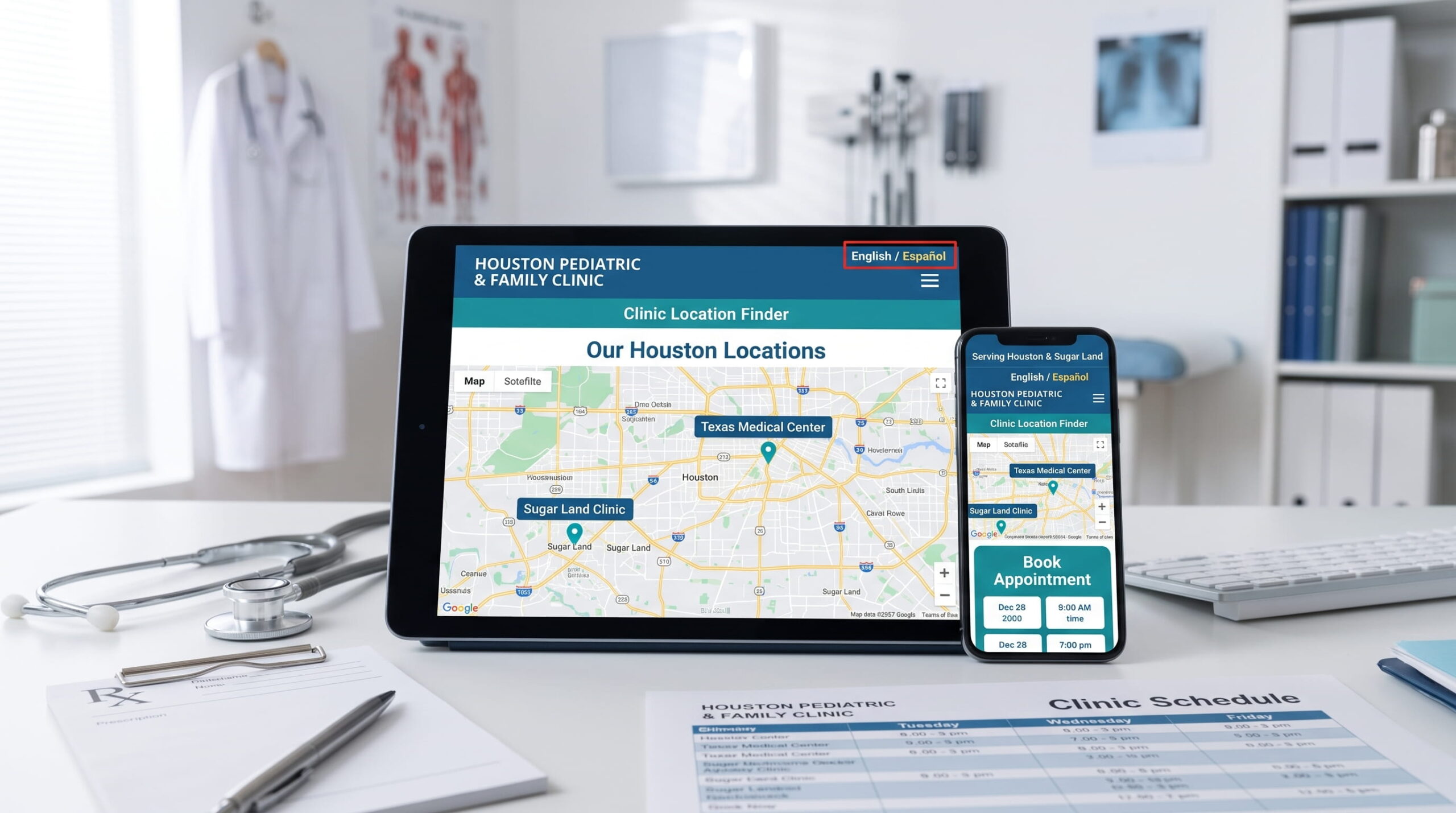
A generic AI prompt doesn’t know what it’s like to navigate Houston traffic or find a specialist in a city where, according to the U.S. Census Bureau, 47.1% of residents speak a language other than English at home. Human designers turn those local realities into functional design features:
- Seamless language toggles placed right in the top navigation bar, not buried in the footer.
- Location-aware navigation modules that clearly distinguish your River Oaks, Sugar Land, or The Woodlands clinics, complete with interactive parking maps for tricky areas near the Texas Medical Center.
- High-visibility alert banners built into the header design for urgent seasonal updates, like prescription refill reminders ahead of hurricane season.
Conversion-Focused Architecture and HIPAA-Safe Engineering
AI can generate a pretty contact form, but it doesn’t understand patient friction or healthcare compliance. Before any site goes live, our specialists audit the technical design from end to end. We streamline mobile navigation so a parent scrolling at 10 p.m. can book an appointment with one thumb, verify that the medical layout aligns with your physicians’ sign-off, and engineer custom intake forms and analytics that protect patient privacy—respecting HHS guidance on tracking technologies and Protected Health Information (PHI).

4 Tips for the Best Website Design for Medical Practices
Nowadays, one of the most decisive factors for any medical practice to have is a modern, optimized website, as it works both as an introduction for new patients and as a way for your loyal patient base can have access to information and other benefits, like a portal....

Website Design for Medical Practices in San Antonio: A Second Opinion on AI-Built Sites
Website design for medical practices in San Antonio got a lot easier the day AI tools learned to build a homepage in minutes. It also got a lot more crowded (Hooray!). Scroll through enough clinic sites in Bexar County, and you’ll notice they’re starting to look kind...
FAQ
Can I just learn how to build an AI website for my practice myself?
You can, and many tools make it easy to start. The hard part comes later: real photos, accurate medical content, local Houston details, and differentiating your brand. Many Houston doctors bring us their DIY site for a “second opinion” once they see it isn’t attracting patients.
Will Google penalize my site for using AI design?
Google says appropriate use of AI fits within its guidelines, and its systems reward content that is helpful, original, and trustworthy. A humanized site gives Google, and your patients, much more to trust.
Do you start over, or can you fix the site I already have?
It depends on the diagnosis. If your AI-built site has a solid structure, we can often keep the framework and focus on content, imagery, and local detail. If there are deeper problems, like slow load times, we’ll explain the case for a rebuild before any work begins
Call Up The Experts on Website Design for Medical Practices in Houston
With proper medical website design, you can provide prospective patients a modern, useful, and practical platform where they can easily navigate and book their appointments. If you want to strengthen your online presence before 2026 ends, a healthcare marketing agency like White Coat Web will be your best ally. Medical practices in Houston that seek HIPAA-compliant, high-converting digital platforms can consult with White Coat Web.
Contact White Coat Web by calling at (210)-618-0921 or let us know in more detail about your request by filling out this online form and we’ll get in touch with you as soon as possible.

Willie White Coat, AKA Graham Dunlap
Graham is a digital strategist with 10+ years of experience leading marketing teams. As the co-founder of White Coat Web, he focuses on modern SEO/GEO and digital growth, helping medical practices expand their online visibility and revenue while adapting to continuously evolving industry techniques.
In his words, “We’re passionate about people, so you can be passionate about your patients.”