

Because healthcare is one of the most competitive industries nowadays, it is essential for medical practices to build a strong brand that prioritizes patients and differentiates itself from direct competitors. How to do it, though? Through a well-planned medical marketing strategy that takes into consideration all the facets involved in your patient’s journey: from initial online discovery to post-treatment follow-up. The moment you start prioritizing your patient’s experience over everything else and, consequently, earn your audience’s trust not just for the short term but for the long-term, your clinic will start aligning with the actual people’s needs. In this article, the experts at White Coat Web are showing you just how to do that through the 3 pillars that will show your community why they should choose you.
Marketing for the Healthcare Sector
While universal marketing principles apply across multiple commercial sectors, healthcare operates within a different framework due to its regulations, patients’ decision-making process, and high-stakes nature. As a result, medical marketing requires more than basic conceptual execution. Today, traditional quantitative metrics like KPIs and ROI fail to capture the intricacies of expanding the patient base. Because digital-era patients now evaluate providers with a new level of scrutiny (online reviews, AI results, etc.), long-term profitability is tied to subjective clinical interactions. As a consequence, the new aim is to elevate the patient experience at every digital touchpoint covering their entire curiosity journey.
What Makes Medical Marketing Different
There are rules and regulations around what physicians can and cannot market online. Besides, the way to communicate with future patients and the motivators behind people finding practices and seeking out treatment are different from, for example, buying a pair of blue jeans.
What’s really unique for physicians like you is not just the burden of care that you provide, but the communication means and methods that you have to take in order to actually reach your audience.
Finally, when you’re communicating about who you are and what you do online, you need people who have experience doing that because communicating and talking about what you do in layman’s terms is not something that comes natural to doctors.
🥼 Watch our 3-minute webisode: Medical Marketing & How It’s Different from Traditional Marketing
Targeting the Community Is Key for Doctors
You know the saying, “If a tree falls in a forest and no one is around to hear it, does it make a sound?” Many practices open their doors without taking into consideration how to attract patients; failing to make themselves ‘heard’ in their community. Although it might seem like a brick-and-mortar office is enough of a look-at-me sign, it is not. Establishing a local presence takes a hybrid medical marketing strategy that includes both traditional and digital techniques to engage future patients in the vicinity.
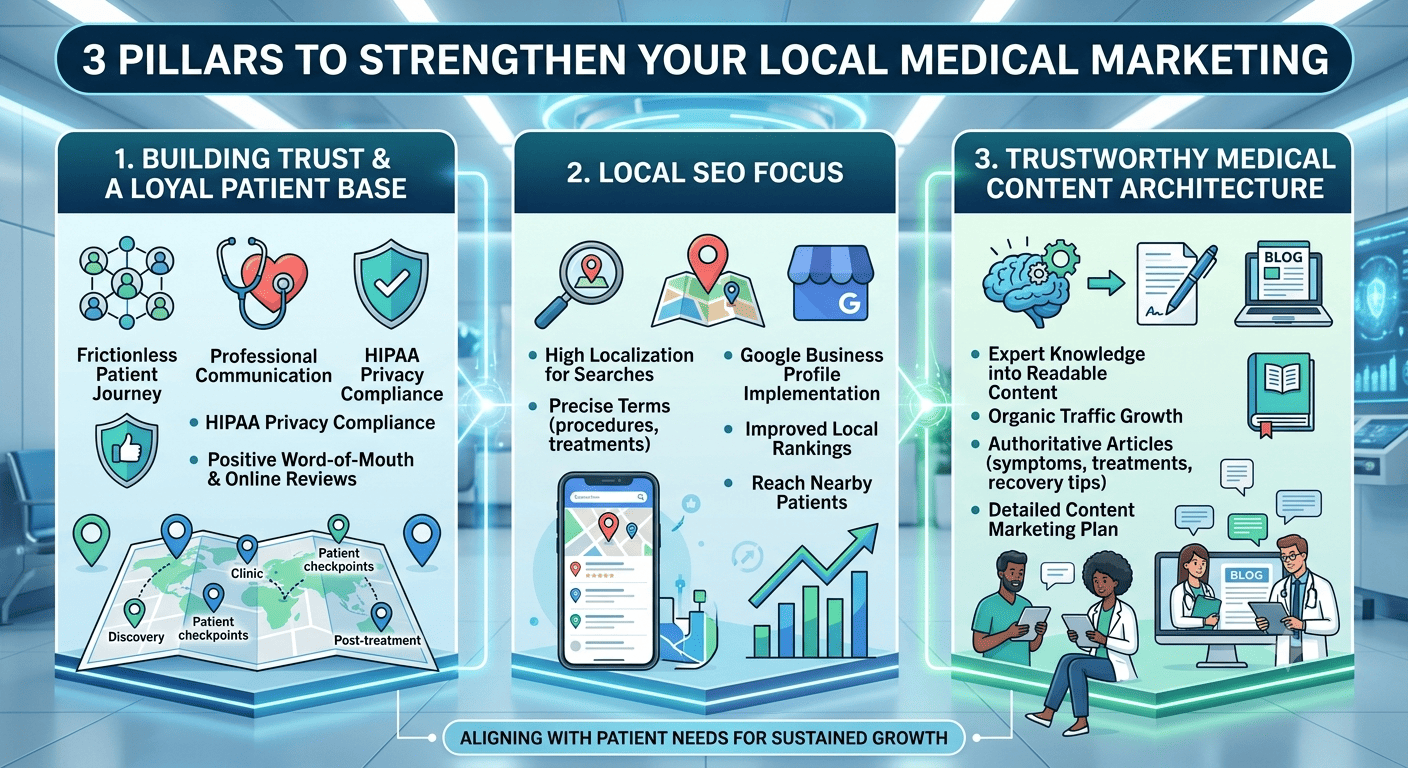
How to Attract Local Patients: The 3 Pillars of Medical Marketing
a) Walk in your Patients’ Shoes
The number one mistake doctors make when building their clinic’s website is marketing their services from their point of view. What does this mean? If an orthopedic surgeon specializes in a complex procedure, they will most likely write about it as if it were a paper for a medical journal—fair enough, it’s what they know how to do!
When it comes to the digital medical office, aka the website, the way to communicate differs. You will put yourself in the shoes of your patients. What common ailments do they bring to the office? What are the most common questions they ask? The answers to these questions contain your keywords—the words that you will center your content on when building your website.
Also, when you produce said content, (i.e., the pages describing your services or blog posts), talk to your neighbors like you are one of them. Think local so that your patients can find you. For example, what are the area’s landmarks? What is the local high school? Harness that information to make them feel closer to you.
🥼 Read more: 5 Of The Best Medical Website Designs
b) Focus on Local SEO
Online searches for healthcare services are highly specific and localized. Think of a parent looking up “pediatrician near me”; that’s your target. If your practice doesn’t appear at the top of these local search results, you are effectively invisible to the patients who need you most.
Optimizing for local search engine optimization (SEO) involves several critical components:
- Google Business Profile (GBP) Optimization: Your GBP is your digital storefront. It must be completely filled out, accurate, and regularly updated. Ensure your practice’s name, address, and phone number (NAP) are identical across the web. Add high-quality photos of your clinic, accurate hours of operation, and a clear description of your services.
- Local citations and backlinks: Ensure your practice is listed in reputable medical directories (like WebMD, Healthgrades, and Zocdoc) as well as local business directories. Earning links from local organizations, schools, or charities further solidifies your standing as a pillar of the community.
c) Review Management
Patients trust other patients. A steady stream of positive, authentic Google reviews not only builds immediate trust with prospects but also signals to search algorithms that your practice is active and reputable. Implement a system to legally and ethically encourage patients to leave feedback post-visit.
This is one of the most important aspects of medical marketing. Leveraging your excellent care can take you to new heights online.
FAQ
How to market a medical practice?
Medical marketing requires a unique approach due to the nature of the medical services. Each specialization has its own specificities when it comes to creating a customized strategy that reaches the expected results. By learning from your patients’ base, their necessities, pain points, and what they are looking for online, the path will start clearing out in front of you.
What are the top 3 marketing trends in healthcare?
- Social media engagement growth has now surpassed traditional TV healthcare ads.
- Streamlining the patient journey while also maintaining HIPAA privacy policies at every interaction will keep patient medical data protected.
- Optimizing for improving ranking and visibility in local search results is one of the biggest growth opportunities.
How do healthcare marketing agencies help clinics attract local patients?
By precisely knowing what’s happening on the healthcare market, the right marketing agency can turn your current online presence into a high-probability opportunity of finding local patients. This is done by prioritizing local SEO implementations on the website, GBP, and social media. Because most of the patients are nearby your clinic, it’s fundamental to take care of every single detail regarding this point so that the probabilities gradually increase.
Check out this blog post for more detailed information: How OBGYN Practices Can Leverage AI for Growth
Start Filling Your Practice’s Calendar with Medical Marketing
By aligning your medical marketing with these three pillars—understanding the patient’s perspective, dominating local search, and perfecting every digital interaction—you shift your practice from a transactional mindset to a relational one.
In a highly competitive healthcare environment, you cannot rely solely on your clinical expertise to attract patients; you must also master how you communicate that expertise. When you prioritize the patient experience at every stage of their curiosity journey, you don’t just build a patient base—you build a trusted community institution.
🥼 Ready to transform your practice’s digital presence? Contact the team at White Coat Web today for a comprehensive marketing audit tailored specifically to your medical specialty.