

Employing strategies like marketing in Spanish can provide new opportunities to grow in a multicultural and competitive field such as the medical one. An approach that makes even more sense in a country like the United States, which is home to the second-largest Spanish-speaking population in the world. Family medicine practices and practitioners are one of the medical branches that can benefit the most from this strategy. Keep reading to discover the advantages that come with applying this tactic and some tips to empower your medical practice with it.
The Spanish-Speaking Landscape in the United States
In the United States, the Hispanic community represents a growing and dynamic population that has been rising exponentially in recent years. As a matter of fact, Spanish is the second most spoken language after English—with more than 60 million people speaking it in the U.S. With data such as that, it just makes sense to think about investing in marketing in Spanish to reach a broader audience and grow in the States.
Why Is Marketing in Spanish Important?
Some may think that marketing is about tricking customers into buying whatever a company tries to sell, which may have been true in the past. However, unlike its predecessor, modern marketing—and especially the digital version of it—is all about the customer, their needs, and their experience. Having that in mind, marketing in Spanish is just another tactic to center the narrative around the customer, address their needs, and improve their experience.
How Can Family Medicine Practices Benefit From This Strategy?
An undeniable truth is that Hispanic communities also need and look for medical care, it is only a matter of finding someone who can address communication barriers for them. For family medicine practices and practitioners, this means seizing the opportunity to reach patients in your community who are actively seeking your care—only in another language. A tactic that can be especially helpful in a field where relationships are based on trust, communication, and connection.
Some benefits of employing this strategy are:
Increased Patient Acquisition
By applying marketing in Spanish strategies, you make sure that patients in these communities are finding your services qhen they need you and reaching out to you—which translates into increased ROI for your practice.
Improved Relationships
In the healthcare field, relationships are the foundation of care. By showing empathy and connection with patients in their native language, relationships develop, and trust and loyalty grow naturally.
Higher Patient Satisfaction
Patient satisfaction increases as a result of breaking down communication barriers; this is significant for medical practices, since patient satisfaction translates to better word-of-mouth.
3 Key Tips to Succeed at Marketing in Spanish
If you’re interested in employing strategies like marketing in Spanish to grow your family medicine practice, you need to know that there are some tips to do it right. Graham Dunlap, the resident marketing expert at White Coat Web, explains the 3 key tips to succeed at bilingual marketing:
1. A Spanish Version of Your Website Is Key
One of the basics when it comes to doing bilingual marketing is having a version of your website in the other language. Your website serves as an online extension of your brick-and-mortar, making it an easy way to convey to Spanish-speaking patients that they’re welcomed in your practice.
Nowadays, patients turn to the internet to look for everything—their symptoms, understand a disease or diagnosis, and choose a medical practice—Spanish-speaking patients are no exception. The main difference is that most of them do their searches in their mother tongue, since patients who have another first language consider it highly important to discuss care in their native language.
That’s why, if you or your staff can communicate with patients in this community in their native language, conveying it through your website is a place to start. To do it, work on having a Spanish version of:
- Home page
- Services
- About/providers
- Contact information
- Blog
Try to communicate which doctors or members of your staff speak their language on your providers page. This way, your patients will know who to look for.
An Example of a Family Medicine Practice With Bilingual Website
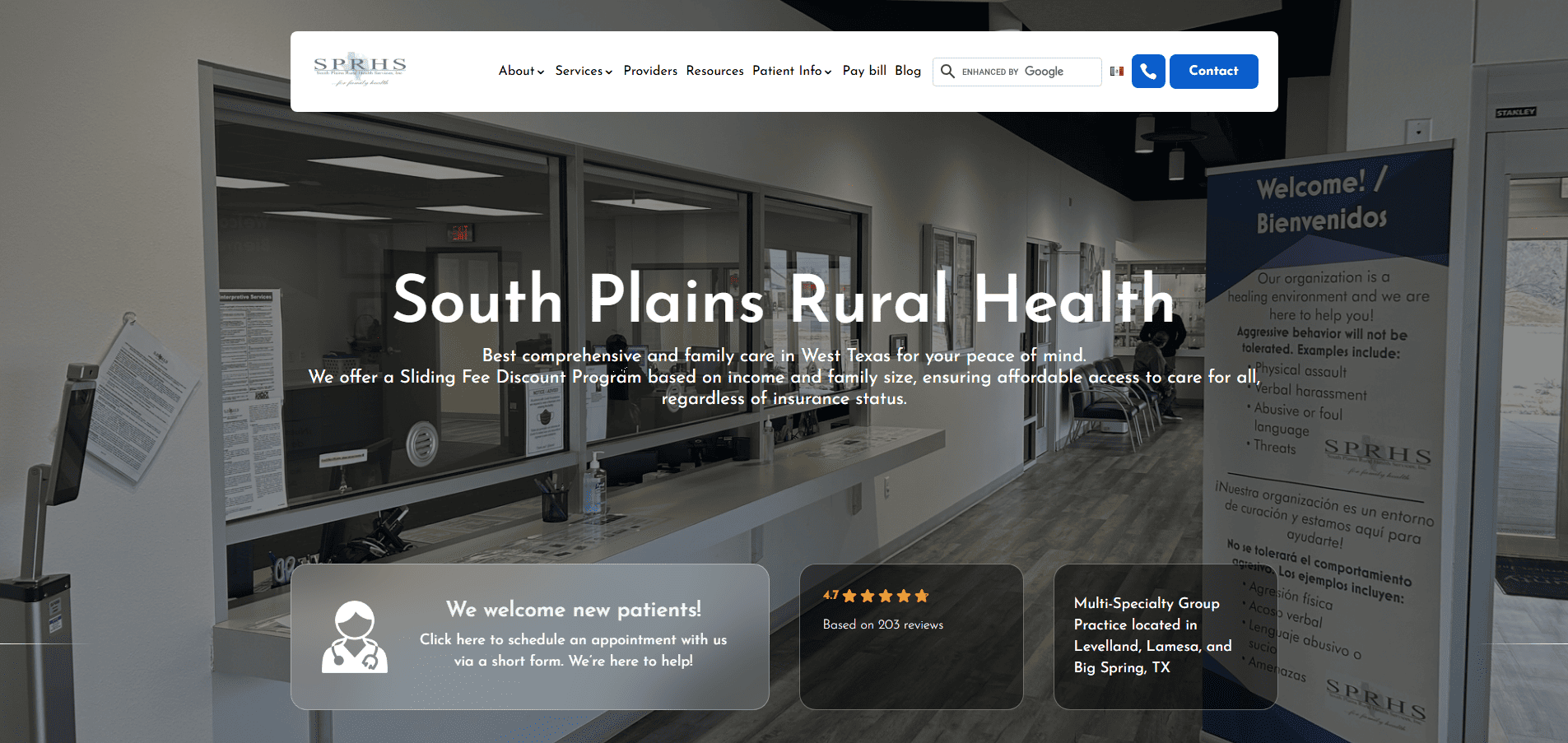
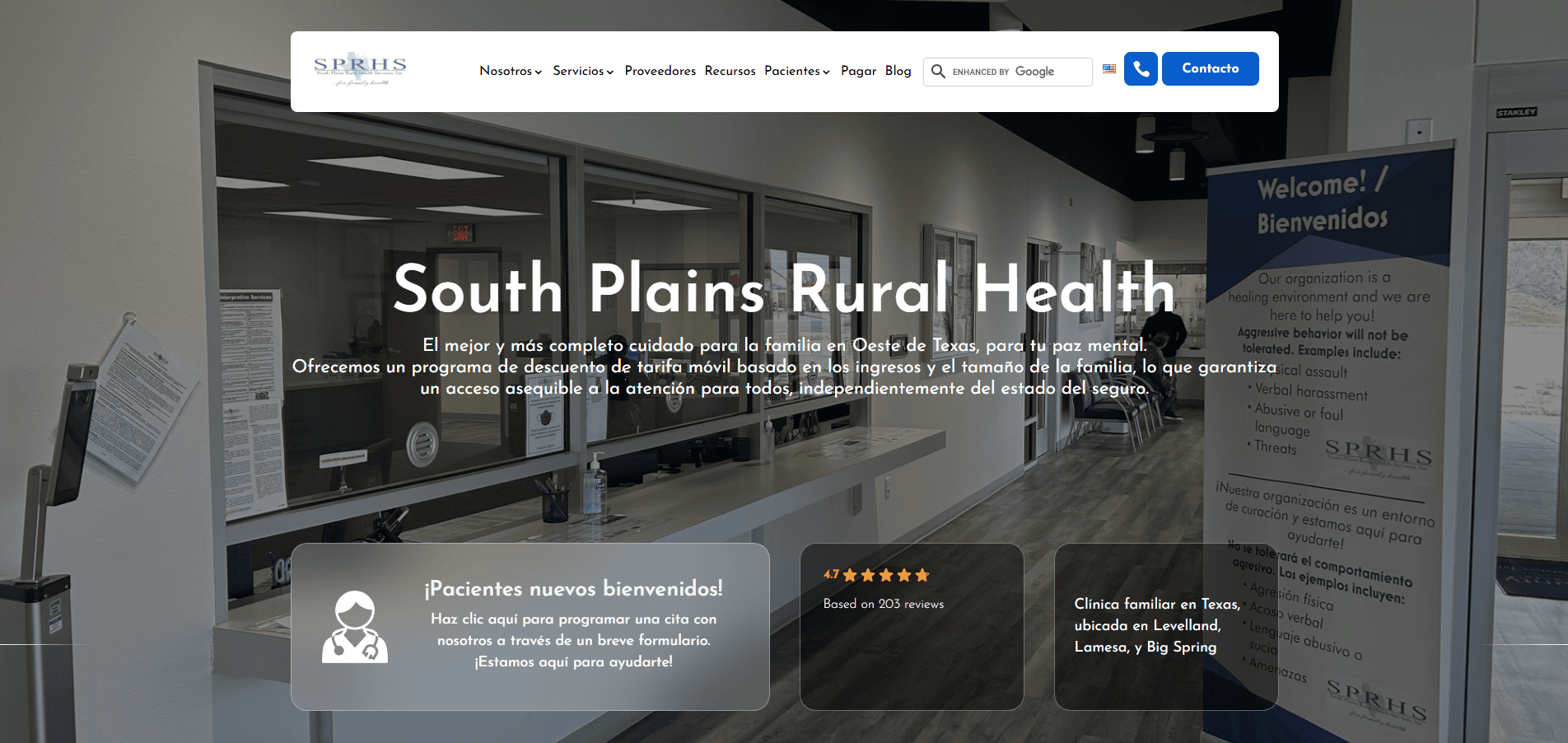
Say a Spanish-speaking mother is looking for medical care for her family in Levelland, Texas. She goes to Google and types “medicina familiar”, in a matter of seconds she finds this website for a family medicine practice called South Plains Rural Health. All the necessary pages are translated to Spanish, which makes it easier for search engines like Google to help Spanish-speaker patients find exactly what they’re looking for.
🔎 Looking for website design ideas? Check 5 of the Best Medical Website Designs to Inspire Your Digital Office
2. Marketing in Spanish Is More Than Literal Translation
Understandably, using translating plugins or automated translations can be tempting to try and optimize the work and have your bilingual site going as soon as possible. However, experts in bilingual marketing advise against this practice, since literal translation often leads to misunderstandings due to errors or a phrase losing its meaning. This practice is ok for short and simple phrases, but it’s not recommended in a professional and sensitive setting such as the healthcare field.
Languages are complex. Words, phrases, and meaning are often attached to aspects such as cultural context, historical references, linguistic nuance, social significance, and so much more. Understanding that will allow you to cross the language barrier and use it as the powerful tool that it is to grow your patient base through localization. To do it right, think about hiring agencies that already have expertise on bilingual marketing or work with native speakers—better yet if they’re also experts in medical marketing.
📺 Check our 3-minute webisode on Bilingual Marketing: Speak Your Patients Language
3. Seize the Opportunity to Build Your Community
Family medicine practices and practitioners are often the first point of contact when a patient needs medical care. This makes relationships between providers and communities essential to guarantee the comprehensive and personalized care that patients need. For Hispanic and Latino communities, family is everything, making it so that trust, loyalty, and relationships are essential for them. See how family medicine and Hispanic communities are based on the same principles?
Building community and localizing content is something that all providers should do as a strategy to gain trust, engagement, and grow. Considering that, now that you’re aiming for Spanish-speaking communities, you should let them know it and take the chance to gain relevance and engage with them. To do it, adapting and unifying your message across platforms is key. For instance, try:
- Finding the right keywords
- Using Spanish subtitles in your videos
- Posting bilingual content in other channels
- Adapting GBP to also include information in Spanish
FAQ
What is the difference between translating and localizing?
Translating is about switching from one language to another—it focuses on linguistic accuracy. Localizing is about ensuring that the content is culturally relevant, going beyond translation to feel native and improve user experience.
How to know if marketing in Spanish is good for me?
If you’re located in areas with high Hispanic populations—like California or Texas—and have Spanish-speakers among your staff, it is likely that thinking about investing in this strategy is a good idea to grow and stay competitive.
Where should I start with marketing in Spanish?
Start by localizing (not translating) your content, prioritize adapting your website, content, and digital presence. Ready to grow your family medicine practice and attract more patients? Get in touch with the team at White Coat Web and put marketing in Spanish to use for you.