

In marketing, localization refers to the whole process of adapting and optimizing content to meet the cultural needs and behaviors of a specific place. For family medicine practices, this means adapting their digital presence, content, and brand to fit into cultural intricacies, patients’ needs, and regulatory compliance. At White Coat Web, we can tell you all about this digital marketing strategy and how to apply it to grow locally. Keep reading.
What Is Localization?
Local SEO strategies are all about adapting content to fit into the specific cultural and local context of your patients. This strategy is crucial to gain relevance, build reliability, and increase brand awareness within communities. An approach that requires optimizing aspects such as language, images, and content. This strategy requires careful tailoring to make it work in your favor effectively. After all, in digital marketing, just like in the healthcare field, there’s no such thing as a one-size-fits-all approach.
Why Is It Key for Family Medicine Practices?
Family medicine practices are often the first point of contact for patients looking for medical services, therefore, local SEO is all the more important for family medicine practices. In the current healthcare landscape, finding ways to gain relevance has become indispensable, hence the need for strategies that put practices in their patients’ radar. An approach like this ensures that providers can be found, exactly when nearby patients need their comprehensive care.
5 Key Elements to Succeed at Localization
Working in marketing localization strategies goes beyond simply creating or translating content. It is about tailoring an approach that helps you gain relevance, trust, and authority within your communities. To do it successfully, there are some practices that we recommend:
1. Google Business Profile for Localization
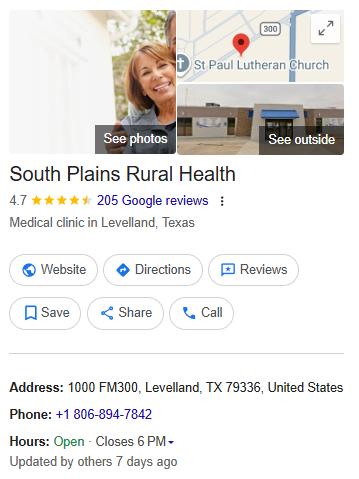
Optimizing your Google Business Profile (GBP) is one of the most important steps to follow when aiming to grow locally. After all, this tool has become the modern and digital successor of the once famous Yellow Pages. Patients who look for medical practices will often go first to Google, meaning that if they can’t find you, it is as if you don’t even exist.
GBP allows practices to provide real-time information for patients to check when they need it, which includes basics like:
- Phone number
- Working hours
- Full address
- Reviews
- Website
- Socials
👉 An example with one of our own: South Plains Rural Health
2. Work On Your Online Reputation
Trust, reliability, and credibility are all crucial for medical practitioners. These elements play a key role in helping patients decide whether or not to go to you. Once, relying only on traditional word-of-mouth used to be enough for them to choose one practice or another. Nowadays, digital word-of-mouth also measures aspects like reputation and reliability through online reviews, stars on GBP, or comments on social media, to name a few.
Considering that, working on building your online reputation is an aspect that should not be ignored when aiming to grow locally. To do it successfully, we recommend encouraging patients to leave reviews on platforms like GBP—in addition to interacting by thanking them, answering questions, and even responding to negative reviews.
3. Family Medicine Content That Connects
Making content focused on your patients, their needs and worries, not only does wonders for SEO, but also for localization—at least when used right. To do it, think about common situations and challenges your patients face locally. Let’s say you’re in Texas, a state where allergies are prevalent all year-round. An example of this is designing content based on that particular situation. That way, when they look for “Ways to cope with Spring Allergies in this state” or “Common allergy triggers in this city”, they’d find your practice and your advice.
📺 Watch our 3-minute webisode on How To Make Your Business Relevant Locally
4. Speak the Language of Your Patients
Language is vital when it comes to both localization strategies and communication—whether it is in your native language or a secondary one. This means using words, terms, idioms, and phrases in a way that people naturally use and understand. Think about your patients and how they talk, the way they ask for information, and how they refer to symptoms and diseases. For instance, they might not naturally look for “paresthesia”, but they most certainly will look for “pins and needles”.
Something similar occurs when translating from one language to another, where some terms can cause confusion, change the meaning of a phrase, or its connotation. That’s why, to succeed at this, you cannot simply use translating tools and hope for a good level of understanding. Good localization strategies often require being able to rely on a team that can convey a message in both contexts and languages effectively.
5. GEO for Family Medicine Practices
Generative Engine Optimization (GEO) is all about optimizing content for AI-powered engines to find it relevant, something that is crucial in this era. At this point who hasn’t heard about artificial intelligence? This modern tool came to shake up the way we do things and that includes medical marketing and practices like localization.
To employ localization strategies for AI successfully, following the aforementioned practices is essential, since these engines will look for the existing information to provide it to patients when they ask for it. Some recommendations for this—given by our resident marketing expert, Graham Dunlap—are:
- Be consistent with NAP (name, address, and phone number) across platforms.
- Work on E-E-A-T (experience, expertise, authoritativeness, and trustworthiness)
- Make content that includes local keywords (street names, reference landmarks, etc.)
🥼 Don’t miss out on 4 Ways to Use GEO to Boost Your Family Medicine Practice
Ready to Grow With Localization Strategies?
Localization plays a key role in a serious point, ensuring that your practice appears accurately and consistently when patients are searching. Similar to placing your brick-and-mortar on a high-traffic street, this strategy increases the possibilities of being found, known, and chosen. At White Coat Web, we specialize in helping practices grow through digital marketing strategies, contact us if you’re looking for your family medicine practice to thrive locally.