

Family medicine practitioners play a key role in healthcare by being the first point of contact for patients who need care or a referral to a specialized provider. Because they’re often the bridge between patients and the care they need, these providers don’t benefit from referrals like other physicians do, making it essential to work on strategies to bring more patients in. Lead generation is a marketing tactic that can benefit most medical practices, but especially the ones committed to primary care.
At White Coat Web, our experts in digital marketing for doctors guide you through the main benefits of this approach and the best strategies to make the most out of it, taking your patients’ journey through the marketing funnel into account. Keep reading.
How Lead Generation Turns Curiosity Into Visits for Family Medicine Practitioners
The journey for family medicine patients when it comes to medical marketing can easily be explained with two terms:
- Marketing funnel: A visual representation of the journey a patient does from discovering your practice’s existence and engaging with it to finally scheduling an appointment.
- Customer journey: The whole experience and interaction journey that a patient can have with a medical practice, usually including awareness, consideration, and decision as the basics.
Both of these can be linear and non-linear paths, meaning that a patient can go from or back to a point or another. Lead generation plays a crucial role for both of these frameworks, since it employs strategies that guide patients through each step of their journey to support the desired final decision, booking an appointment.
Why Does Lead Generation Matter for Family Medicine Providers?
As we mentioned before, these providers are usually a first point of contact between patients and their care, meaning that they often don’t benefit from referrals like other doctors do. Because of that, they are the ones who have to take matters into their own hands and make sure that patients can find them to reach out to them.
📺 Watch our 3-minute webisode on Family Practices
Key Strategies to Lead Patients Right to Your Practice’s Doors for Each Part of the Funnel
Just like the journey of your patient is usually non-linear, the practices employed through digital marketing to guide and support them are also flexible. Lead generation is not a single strategy, but a whole process that involves identifying the best way to attract potential patients and transforming that initial interest into real action. This process can differ between specialties, but for family medicine practices it can look something like this:
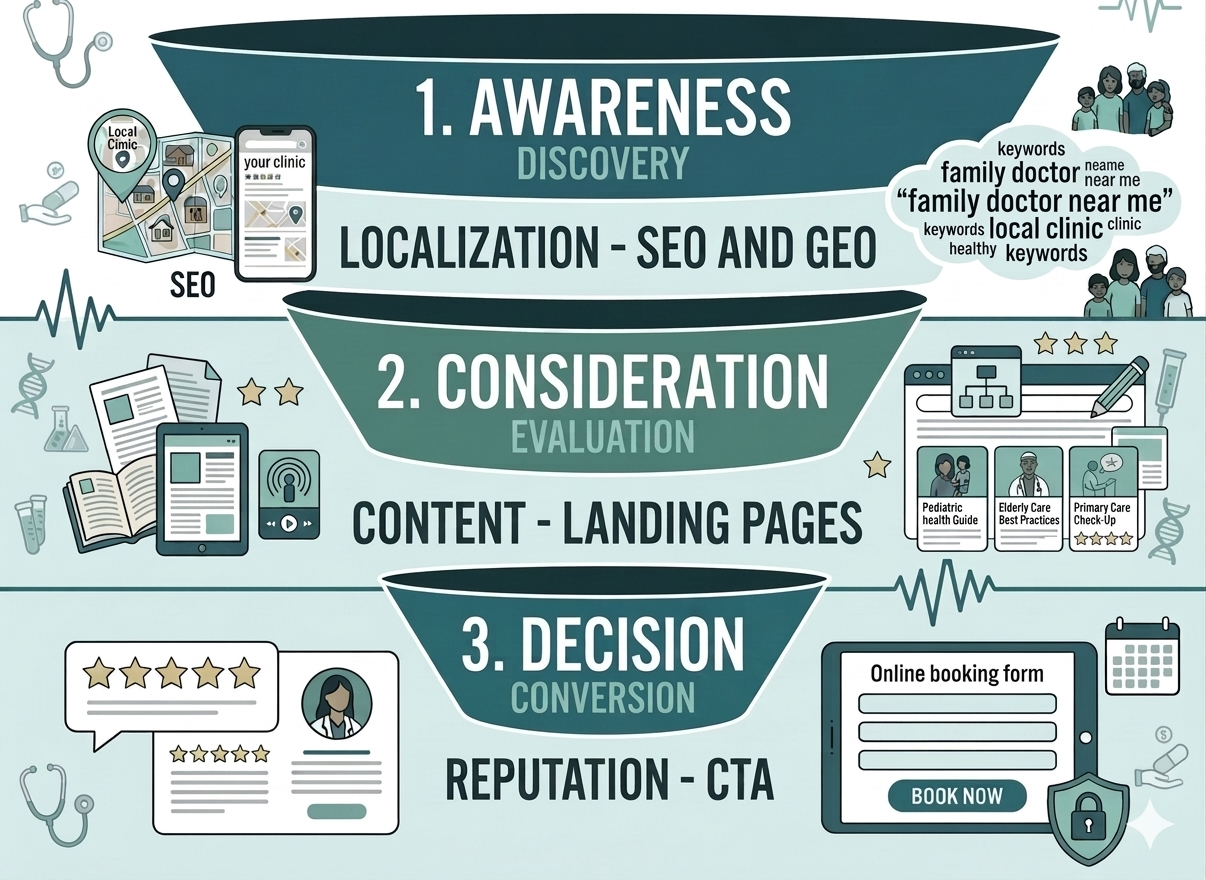
Awareness (Top of the Funnel)
Awareness represents the top and widest part of the funnel. This is oftentimes the start of everything, where patients discover what you do, where you do it, and how you do it, through different means and channels. To support patients during this initial stage, it is key to provide all your essential information. At White Coat Web, we recommend these two approaches to accomplish that:
Localization tactics
One of the most influential factors for patients to choose and filter between providers is proximity to the doctor’s office, because of the continuous nature of this type of care. This is where working with strategies like localization for doctors can play a key role in letting them know that you’re exactly where they need you, close to them.
Optimized SEO and GEO
Patients nowadays turn to search engines like Google and generative engines like Gemini to look for medical-related information, which includes doctors and treatment options. Taking the lead by working on search engine optimization and generative engine optimization is key to appear in your patients’ searches and AI-generated answers.
🥼 You might be interested in Medical SEO in Times of AI (GEO and Other Gimmicks)
Consideration (Middle of the Funnel)
By this stage of the funnel, patients are usually already interested in your care and probably considering your offer, hence the name. It is crucial to show them how your practice can provide the solutions they’re looking for from a family medicine physician. Two of the best strategies to support them during this middle part of the funnel are:
Content for your patients
One of the best ways to show patients that you’re the answer to their problems is by providing the answers yourself, literally. Content can be a great tool to achieve this, since it allows you to address real problems and questions, and to provide the information they need without requiring previous interaction.
Specialized landing pages
There’s no better way to show patients that you’re the answer they look for than by appearing in their searches. If you provide pediatric care, elderly care, or chronic disease management services in your area, it is best to let patients know that through specialized landing pages that appear first when they look for those services.
An example of a family medicine practice with a dedicated landing page
If a patient in Lamesa, Texas were to look for a “chronic disease management clinic near me” on search engines or generative engines, they would find South Plains Rural Health Services. This is thanks to their specialized landing page on the subject, achieved by putting into action strategies like SEO, GEO, and localization working together.

🔎 Looking for website design ideas? Check 5 of the Best Medical Website Designs to Inspire Your Digital Office
Decision (Bottom of the Funnel)
This is the decisive part of the funnel, where the magic happens and initial research and curiosity turn into real action in the form of conversion. As we mentioned earlier, the whole process is not linear and patients who were in the awareness part can jump right here or go from here back to consideration. Nonetheless, supporting this part of their journey with strategies that make the process of reaching out to you smoother is key. Here are the two approaches that we recommend for this decisive stage.
Building trust and reliability
The relationship between family medicine providers and their patients is built on trust and reliability. In medical marketing, applying strategies that support this essential part of their interactions is key. As a doctor, taking an active role in what’s said about you is possible by engaging with your patients through testimonials and reviews, sharing case studies and credentials, among other practices.
Clear CTAs
If your potential patient is already convinced and ready to reach out to you but doesn’t have a clue how to contact you, that can be a major problem. Because their journey is completely unique and oftentimes non-linear, don’t assume that having clear and visible calls to action (CTAs) in the awareness part is not necessary. Always make sure that patients know how to contact you in each stage of their journey.
FAQ
Is lead generation illegal for medical practices?
No, lead generation in itself is not illegal. However, doing marketing for doctors and medical practices properly requires being familiar with guidelines and regulations on both the medical field and marketing to avoid legal problems and penalties.
Is it difficult to generate leads for family medicine?
Yes, while generating leads for family medicine practices and practitioners can be challenging, requiring you to overcome difficulties and a long decision cycle, with a thorough and robust strategy it can be achievable.
Where should I start in lead generation?
Start by understanding both your patients and your unique value. Once that’s covered, focus on finding your patients where they are, gaining local visibility, and building both trust and reliability.
Schedule Your Most Important Appointment With Marketing Strategies
If you’re looking to grow locally and bring more patients in through strategies like lead generation, contact us. At White Coat Web, we understand how demanding your job as a family medicine provider is. With us, you can find a medical marketing agency ready to help you grow with the latest strategies and practices in the field, while you can focus on what’s more important to you, keeping your patients healthy.