
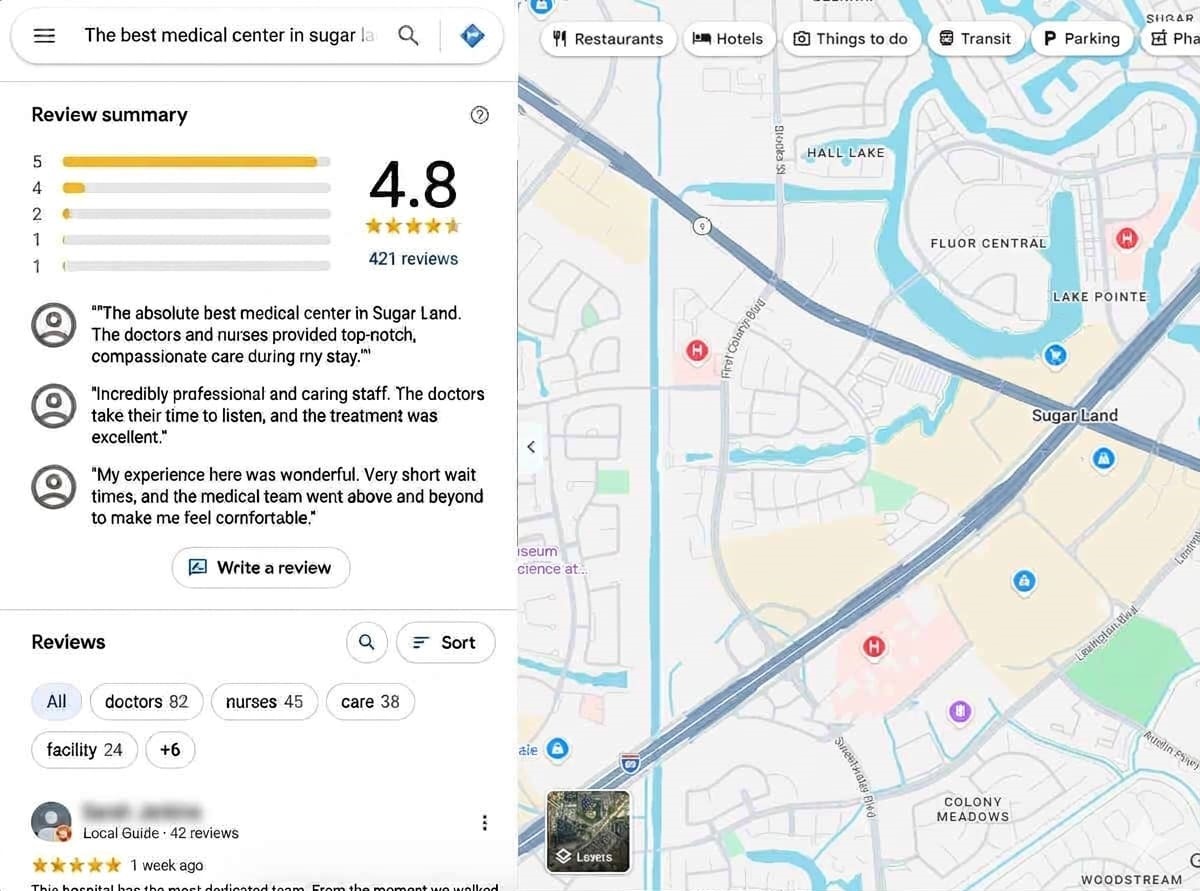
Patient trust is one of the most important aspects to work on as a healthcare provider. But with everything being digital nowadays, how can doctors shape their reputation, increase credibility, or build trust? The answer lies in the modern version of word-of-mouth, Google reviews for doctors. In this day and age, prospective patients trust the opinions of people on the internet as much as close friends. In a competitive and complex medical landscape like the one seen in Houston, leveraging all the advantages can make the difference between being chosen or fading away among the crowd. That’s why here are the 3 best practices to take part in shaping your online reputation. Read on.
Houston’s Complex Medical Landscape
Houston ranks as the 4th largest city by inhabitants with a population of roughly 2.3 million people according to the Census Bureau. For providers, this could mean more people to take care of, but the setback lies in the complex medical and demographic landscape found in the city. The Texas Medical Center, also known as the world’s largest medical complex, drives intense competition for providers to feature in search engines and catch patients’ attention.
How Google Reviews for Doctors Impact Your Practice in Houston
Competing in a medical field where big hospitals like the Texas Medical Center (TMC), Houston Methodist, or MD Anderson require a deliberate digital strategy. Tactics like Google reviews for doctors can provide help in positioning your practice on the radar of potential patients by:
Increasing visibility
When a medical practice appears on platforms like Google Business or Google Maps, it increases the chances for people to discover them and see what actual patients have to say about their care.
Sending trust signals
Star ratings and customer reviews on Google Business Profile (GBP) be trust signals for potential patients to learn about the quality of your care and be a deciding factor to choose you over others.
Boosting localization
For most doctors, being known locally is one of the main purposes of going online. Google reviews can support local growth, especially when the profile is optimized and patients are leaving reviews.
Featured Posts

4 Tips for the Best Website Design for Medical Practices
Nowadays, one of the most decisive factors for any medical practice to have is a modern, optimized...

Website Design for Medical Practices in San Antonio: A Second Opinion on AI-Built Sites
Website design for medical practices in San Antonio got a lot easier the day AI tools learned to...
3 Best Practices to Embrace Google Reviews for Doctors
Digital marketing relies on strategy, personalized and adjusted for each field and practice to provide the best results possible. Each tactic has its own series of best practices. That’s why simply improvising when going online can prevent doctors from achieving results. Here are the 3 best practices when it comes to improving Google reviews for doctors:
- Claim or Optimize Your Google Business Profile
- Be Consistent With Your NAP Across Platforms
- Encourage Patients’ Reviews and Engage With Them
Claim or Optimize Your Google Business Profile
Claiming and optimizing your Google Business Profile can help control how you appear on Google Search and how you’re found on Google Maps. Moreover, it can also provide one of its more important features, and what people check the most when looking for a provider, Google reviews. This is a space where patients can talk about your care and where people trying to find services like yours discover what others have to say about you. In other words, this is where star ratings and patients’ reviews turn into trust, credibility, and reliability.
Leading by example: a case of our own
If a patient were to look for a pediatrician near Radius West, in Houston, TX, they could easily find Katy Pediatric Associates, along with its contact information, address, and more. Additionally, with over 500 Google reviews and more than 4 stars in ratings, parents looking for a provider to treat their baby, children, or teenager have enough facts to check before choosing them.
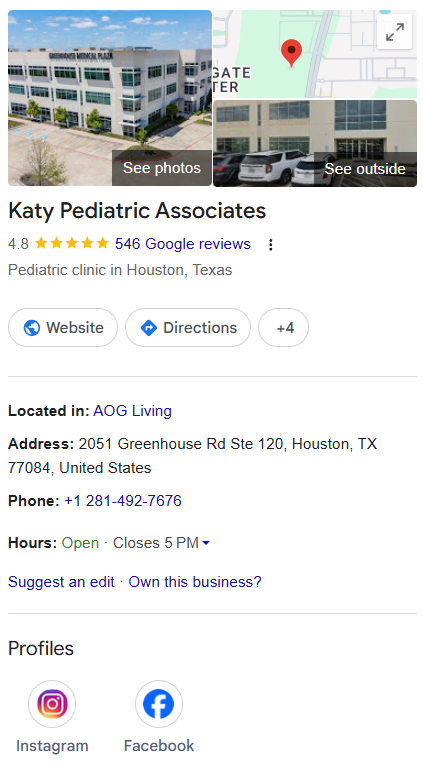
If your practice is not listed or properly optimized, you could be missing an important chunk of patients to practices that are. Setting up your GBP is the first and most important step to support potential patients in their journey to discover you.
Be Consistent With Your NAP Across Platforms
As our resident marketing expert, Graham Dunlap, mentions in the following video, for people to find a practice, the information needs to be updated. What he refers to is none other than name, address, and phone number, also known as NAP. This is the personally identifiable information of your practice, except this one can and should be public.
Giving people a hard time trying to figure out which of the listed information is the right one is only a shortcut to finding negative comments or low star ratings on Google reviews. Whether on social media, GBP, or listing platforms for doctors, this information should be consistent and up to date at all times. It can seem simple, but practices like this are key to avoid confusing or upsetting potential patients.
📺 Check our 3-minute webisode on: Google Business Profile is Still Important
Encourage Patients’ Reviews and Engage With Them
One of the most important aspects to succeed at Google reviews for doctors is to have actual comments that people can check before making a choice. First impressions matter. That’s why, having few reviews across several years, no interaction, or a majority of bad comments, doesn’t send a trustworthy message. Getting patients to leave testimonials can sometimes seem complicated, but there are some methods that can assist in making this possible:
- Encourage patients: Share a QR code at the office or send a follow-up link after a patient’s visit.
- Wait for the moment: Ask for a review at the right time, after a successful treatment or consultation.
- Prepare your staff: Train your staff to politely ask satisfied patients for a review after a visit.
- Be grateful: Take the opportunity to interact with patients and thank them after they leave a review on Google.
🥼 Discover more about Healthcare Review Management: 7 Top Tips
What our clients have to say
“The entire team was great from the beginning. They worked so fast to have at least a page up for us since we didn’t have one. Love working with them. Keep up the amazing work and positive attitude you guys have!”
Katy Pediatric Associates.
FAQ
How do I get more reviews as a doctor?
There are several ways to get more reviews: automated requests through emails or text messages are one, while training your staff to ask for them or doing it yourself is another. To increase the probability of success try to provide a QR or link to your GBP when you ask.
How do I manage negative reviews?
No matter how upsetting the situation is, respond quickly and maintain a professional tone. Acknowledge the patient’s bad experience, thank them for the feedback, and try to move the conversation offline. Don’t try to report the comment unless it is fake or contains inappropriate language.
What should I do when a review is fake?
Remain calm and take action immediately. Respond politely clarifying that you have no record of this person as a patient. Do not argue and report the suspicious comment as spam or fake as per the platform’s guidelines.
Leverage Google Reviews for Doctors to Boost Your Reputation in Houston
Good or bad testimonials shape a practice’s reputation in online spaces, building trust, reliability, and letting potential patients know if choosing them is the right choice. Google reviews play a key role for doctors to translate comments into credibility, but it can require knowledge on practices like review management. If you’re aiming to build the reputation of an expert in your area, contact us. The team of experts in medical marketing at White Coat Web is ready to help you.

Willie White Coat, AKA Graham Dunlap
Graham is a digital strategist with 10+ years of experience leading marketing teams. As the co-founder of White Coat Web, he focuses on modern SEO/GEO and digital growth, helping medical practices expand their online visibility and revenue while adapting to continuously evolving industry techniques.
In his words, “We’re passionate about people, so you can be passionate about your patients.”