

The wellness industry is on a seemingly non-stop, fast-track to limitless growth. With a $6.8 trillion peak in 2025, it’s fair to say competition among med spas and providers is high. Paired with this, its main target consumers (millennials and Gen-Z) are increasingly turning to AI to find providers. For medical spas and wellness centers, this means widening their patient acquisition strategy to meet their base where they are: AI via GEO. Where to begin, though, can be a challenge. Below are key strategies med spas can implement to harness the power of generative engine optimization to establish their authority and expand their patient base.
The Ever-Growing Competition Within the Wellness Industry
The 2025 Global Wellness Institute Economy Monitor report revealed that the wellness market hit $6.8 trillion in 2024 and is projected to reach $9.75 trillion in 2029. When focusing on med spas, industry revenues will grow to an estimated $228.0 billion in 2029 globally and $34.79 billion in North America.
Among drivers of this rise are:
- Wellness has become a universal pursuit and a strategy to counter the rising threats of aging, chronic disease, and stress.
- An increase in consumer spending (4.2% compared to the global GDP growth rate of 3.9%), reflecting a cautiously optimistic consumer spending environment that has spilled over into wellness-related spending.
- A post-pandemic mindset shift, with growing emphasis on prevention, mental health, and personalized care driving demand.
- The proliferation of aesthetic and regenerative treatments, as technological advances make medi-spa services more accessible, effective, and normalized.
No longer a niche segment, the medical spa arena has become one of the most competitive, attracting new participants, from independent providers to chains and luxury hospitality brands. As a result, med spas should aim for a hyperlocalized and personalized positioning—which Generative Engine Optimization (GEO) provides.
What Is Generative Engine Optimization (GEO)?
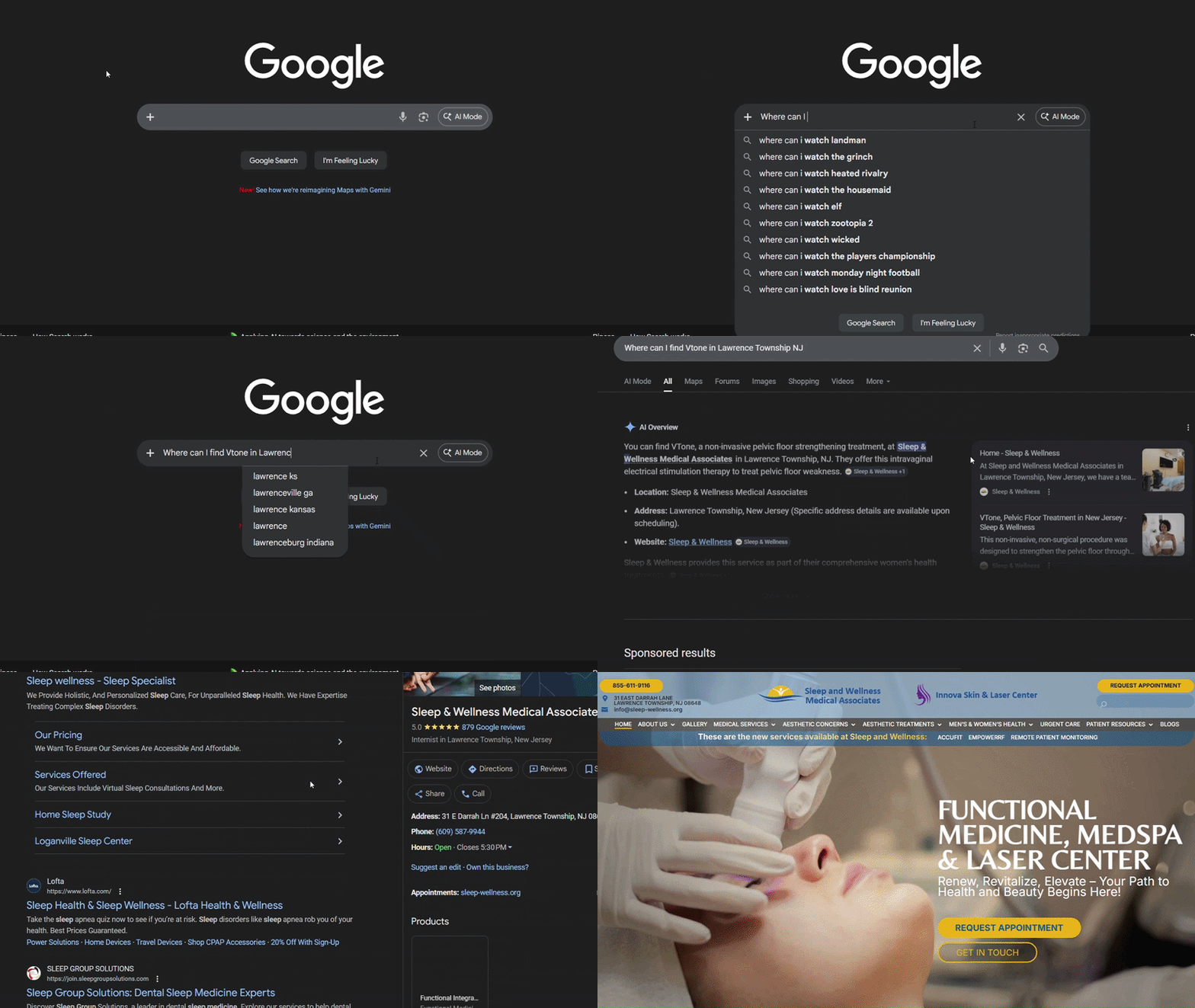
Generative Engine Optimization (GEO) is the process of making the content on a med spa site quotable for AI engines like ChatGPT, Gemini, Claude, and Google’s AI overviews (see example below). Generative artificial intelligence platforms create their content by extracting and synthetizing information from authoritative sources online. However, not all the information online is optimized to be spotted and selected by AI engines, which is where GEO plays a crucial role.
What Does GEO Mean for Med Spas?
In the United States alone, the wellness industry represents more than $500 billion in annual spend, growing at 4 to 5% each year. As mentioned above, among the drivers are that millennials and Gen-Zers prioritize their physical and mental health more than their previous generations and that technology advances at a faster pace than ever: a match made in heaven.
Consumers’ demand grows as the market provides. However, for providers this translates into higher levels of competition, to which a layer of complexity is added: how consumers find providers to meet their needs. These wellness-conscious individuals find their providers online, and not only on Google or social media, but through AI.
According to a survey published in an article on Yahoo! Finance:
- 91% of frequent AI users utilize popular large language models (LLMs) such as ChatGPT for their internet searches.
- 83% of users find AI-powered tools more efficient than traditional search.
- Users cite the ability to receive cohesive responses without clicking through multiple links as a primary advantage.
For med spas, in conclusion, the rise of AI queries translates into the need to design and implement a GEO strategy to connect with their prospective patients.
📺 Watch the 3-minute webisode: Marketing for Wellness Clinics below
An Example of a Med Spa with a Good GEO Strategy
Say a millennial Lawrence Township, NJ, resident has heard of V-Tone, an innovative pelvic floor treatment, and wants to learn more before booking a consultation. She goes to Google and types: “where can I find V-Tone in Lawrence Township, NJ?”
Within seconds, the AI overview generates a confident, conversational response listing a med spa in the Lawrence Township area as the recommended provider. This medi-spa because their website features a well-structured, clearly written service page on V-Tone that answers common patient questions, uses natural language, cites credible sources, and is consistently referenced across trusted directories and review platforms. The AI recognized it as an authoritative source and surfaced it—no paid ad required.
3 Tips to Implement a GEO Strategy for Medical Spas
1. Write Well-Structured Content
When AI engines scan the web for answers, they favor content that is easy to parse and directly responsive to how real people ask questions. For med spas, this means organizing service pages and blog posts with clear headings that mirror user intent—think “What is microneedling and is it right for me?” rather than a generic “Our Services.” Incorporating FAQ sections at the bottom of key pages is equally powerful, as they anticipate the follow-up questions a prospective patient might ask an AI chatbot. The goal is to make your content so well-organized and clearly written that an AI engine can lift a confident, accurate answer directly from your page—and credit your medi-spa as the source.
2. Keep Content Fresh
AI engines prioritize accuracy, and accuracy implies recency. A page last updated in 2021 signals to both AI and patients that the information may be outdated—a particularly costly perception in the med spa space, where treatments, technologies, and best practices evolve rapidly. Regularly revisiting your content to reflect the latest procedures, updated pricing structures, new providers, or emerging research keeps your pages competitive in AI-generated results. Adding visible last-updated dates, brief change logs, or content update notes further signals to AI engines that your content is actively maintained and trustworthy. Even small, consistent updates—a new statistic, a refined treatment description, a fresh patient FAQ—can meaningfully improve how often your content is surfaced and cited.
3. Let Your Credentials Show
AI engines are designed to surface authoritative sources, and authority in the med spa space is built on verifiable expertise. This means every piece of content should feature well-supported claims backed by citations from credible sources—whether that’s a clinical study, an industry report, or a recognized medical association. Equally important is a clear author identity: service pages and educational articles should include provider bios with credentials, licensing information, and links to verified professional profiles.
When an AI engine can trace your content back to a named, qualified professional with a verifiable digital footprint, it is far more likely to treat your med spa as a citable authority — and recommend it to the patients actively searching for the services you offer.
FAQ
How does GEO help med spas?
By implementing a GEO strategy, med spas are able to connect with their prospective patients when they look for their services on AI engines. When an AI recommends your med spa directly in response to a query, that carries significant weight similar to a personal referral, which is especially powerful in healthcare where trust is paramount.
How does GEO differ from SEO?
Implementing GEO is not a replacement for SEO, it’s a complement. It’s about joining patients on their journey, which now includes AI searches. GEO and SEO are built on the same keyword strategy (although for GEO they are “entities”), user experience and intent, quality of content, technical optimization, authority, and flexibility to adapt.
Where should a med spa start with GEO?
The best starting point is auditing your existing service pages. Ask yourself: does each page clearly answer the questions a prospective patient would ask an AI? If not, begin by rewriting your top services with structured headings, FAQ sections, and cited claims. From there, ensure your providers have visible bios with verifiable credentials, and that your business is consistently listed across trusted directories. Small, intentional improvements to your most trafficked pages can yield meaningful results before expanding your GEO efforts site-wide.