

A pregnant woman asks ChatGPT, “What is the best OBGYN near me?”, is your practice the one AI recommends? With Internet users turning to AI for their queries and search engines incorporating AI answers subsequently, GEO has become the new and evolved SEO partner. For OBGYN practices, this means widening their patient acquisition strategy to meet their base where they are: AI engines. Where to begin, though, can be a challenge. Below are key strategies you can implement to harness the power of GEO and establish your authority to expand your patient base.
The State of the OBGYN Field in the U.S.
Approximately 20,000 OBGYNs are employed in the United States, with most working in physicians’ offices, hospitals, and outpatient care centers. Across the country, they are heavily concentrated in California, New York, and Florida; with Hawaii, New York, and Alaska showing the highest concentration relative to their workforce.
What does this say? Practices outside these areas might be struggling to attract patients due to the localized nature of the competition. As a result, practices should aim for a hyperlocalized and personalized positioning—which GEO provides.
What Is Generative Engine Optimization (GEO)?
GEO refers to the optimization of website content so that it can be readable and quotable by generative AI engines like ChatGPT, Gemini, Perplexity, Claude, and Google’s AI overviews. These platforms “create” their content by extracting and synthesizing information they find on authoritative sources online. However, not all websites contain optimized content, making them invisible—this is where GEO strategies play a crucial role.
What Does GEO Mean for OBGYN Practices?
With gynecology being a very personal and sensitive topic, patients tend to confide in their phones. Whether a pregnancy, fertility, STI, or menopause concern, searches are highly intentional and emotionally driven. What’s more, the way individuals conduct the search has shifted from the Google era—they are speaking to the engine, rather than typing keywords.
Who are they talking to? It could be you. When AI produces an answer to an OBGYN-related question, it scans the Internet for authoritative and relevant information—therefore, the content on your site must be written in a way that not only highlights your authority, but also places you near the patient. What good is it for a pregnant woman in the US who is asking about insurance to get an AI reply crafted with sources from France?
Apart from that, in the GEOsphere, OBGYNs face competition from large hospital systems that already have strong content.
In short, the rise of AI queries translates into the need to design and implement a GEO strategy to connect with prospective patients.
📺 Watch the 3-minute webisode: Ep 57 How Marketing for Gynecologist Offices Can Be Unique
An Example of an OBGYN Practice with a Good GEO Strategy
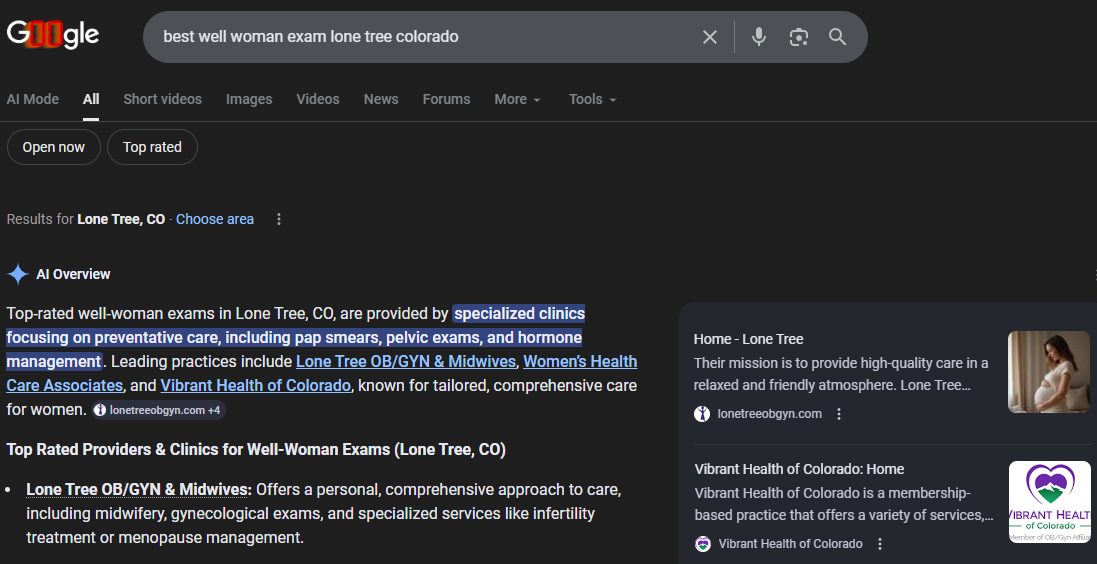
Say a millennial Lone Tree, Colorado, resident is looking to book a well-woman consultation. She goes to Google and types, “Where can I find the best well-woman exam in Lone Tree, Colorado?”
Within seconds, Google’s AI overview generates a confident, conversational response listing Lone Tree OBGYN as the recommended provider. This office appears because their website features a well-structured, clearly written service page on well-woman exams that answers common patient questions, uses natural language, cites credible sources, and is consistently referenced across trusted directories and review platforms. The AI recognized it as an authoritative source and surfaced it—no paid ad required.
3 Tips to Implement a GEO Strategy for OBGYN Practices
- Write Well-Structured, Relevant Content
- Make Regular Updates—and Make a Note of It
- Let Credentials Show
1. Write Well-Structured, Relevant Content
When AI engines scan the web to provide answers, they favor content that is easy to quote and directly responsive to how real people ask questions. For gynecologists and obstetricians, this means organizing service pages and blog posts with clear headings mirroring the intention of the user—think of a “What is the most effective contraceptive?” section within a landing page. Incorporating FAQ sections at the bottom is equally powerful, because they anticipate the follow-up questions a prospective patient might ask.
The goal is to make your content so well-organized and clearly written that an AI engine can lift a confident, accurate answer directly from your page—and credit you as the source.
📺 Watch our 3-minute webisode: Simple Tips for Practices Who Want to Market
2. Make Regular Updates—and Make a Note of It
AI engines prioritize recency, which translates into accuracy. If the last update on a page is from 2021, both AI and patients will find the information might be outdated. In the field of medicine, and OBGYNs, specifically, constant evolution in research and technology make this ever-more relevant. As a result, you want to regularly update the content to reflect latest procedures, providers, or research, and make this visible via change logs, or content update notes that signal AI engines that it is trustworthy.
3. Let Credentials Show
AI engines are designed to surface authoritative sources, and authority in the medical field space is built on verifiable expertise. Therefore, every piece of content should reflect citations from your providers or scientific research. Service pages and educational articles should include provider bios with credentials, licensing information, and links to verified professional profiles. When AI engines detect qualifications, it is far more likely that they will treat your OBGYN practice’s site as a credible resource—and actively recommend it to patients looking for your services.
FAQ
How does GEO help OBGYNs?
By implementing a GEO strategy, OBGYN professionals can connect with their prospective patients when they look for their services on AI engines. When an AI recommends your practice directly in response to a query, that carries significant weight similar to a personal referral, which is especially powerful in healthcare, where trust is a building pillar.
How does GEO differ from SEO?
GEO is a complement for SEO. Both are built on the same keyword strategy (although for GEO they are structured as questions and answers), user experience and intent, quality of content, authority, and flexibility to adapt. Ultimately, SEO walked so that GEO could run—while SEO is specifically designed to showcase your content to search engine users, GEOs purpose is to bring your content to AI engines.
Where should an OGBYN practice start with GEO?
Begin with an audit. The question is: do my pages and content clearly answer the questions a prospective patient would ask ChatGPT? If not, it’s time to rewrite them incorporating clear headings, FAQ sections, and author qualifications. Small, intentional improvements to your most trafficked pages can yield meaningful results before expanding your GEO efforts site-wide.
Parallelly, you may ask a digital marketing agency for doctors to perform an audit and design a GEO strategy for your OBGYN practice. At White Coat Web, we specialize in GEO techniques for doctors’ websites so that you can focus on what you do best—provide excellent care to (more and more) patients.