

Giving each of your patients a seamless experience requires not only providing first-rate attention but also ensuring medical information is handled, filed, and streamlined properly. That way, every procedure and the results after any medical service taken at your clinic can be integrated with outside systems when needed, including external laboratories, billing platforms, and state health databases.
This is where EMR system integration comes into play: it helps bridge gaps between providers while keeping patient information safe and compliant with HIPAA and New York state audit requirements. If you are planning to execute this process correctly, we invite you to keep reading.
How EMR System Integration Improves a Clinic’s Workflow
Let’s start by understanding the positive impact that EMR system integration has on your clinic’s operation, which, in the long term, will result in a better and more efficient relationship with your patient base. Before exploring the benefits for your clientele, we must first look at how integrating your patients’ medical information streamlines your clinic’s behind-the-scenes internal processes.
- Automation of Processes: With EMR system integration, there won’t be a need to manually transfer patients’ information from one data system to another thanks to automation, which minimizes human error and workers’ time to focus on other tasks.
- Real-Time Clinical Decisions: During medical consultation, when the doctor can access all the patient’s information across different platforms, attention will be more accurate and effective.
- Revenue Cycle Management (RCM): Finally, the workflow improvements will also happen in the financial area, as billing is also included in the EMR system integration, resulting in a clearer cash flow for the clinic.
🔍 Read more: How Ambient EMR Integration is Reclaiming 15 Hours a Week for Clinicians in 2026
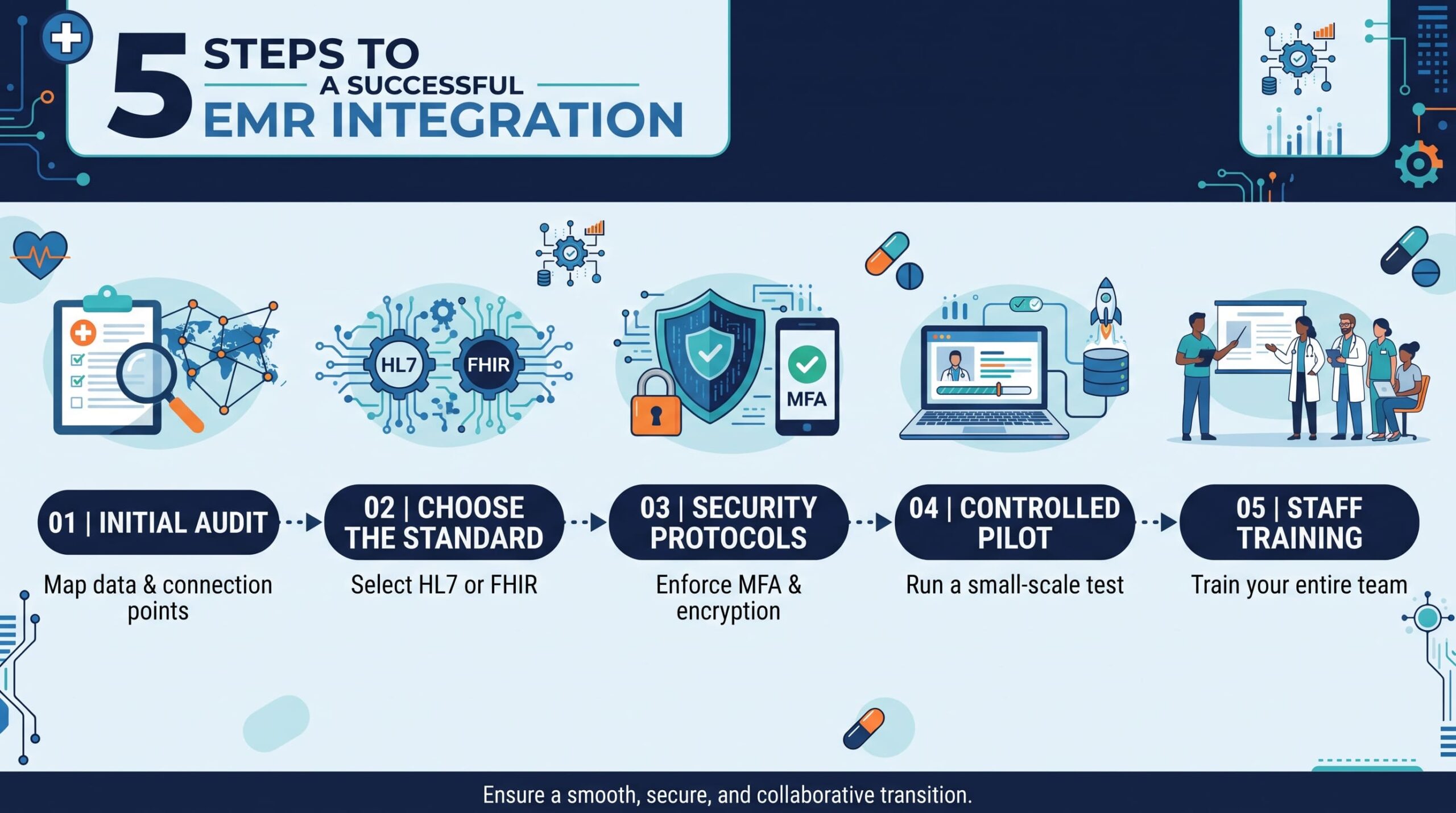
5 Steps to Execute a Successful EMR Integration
Getting to that point where the EMR system integration starts improving your clinic’s operation requires a series of steps, including:
1. Initial Audit
By correctly identifying the crucial points where the integration process should connect the internal with external data systems, you will create a clear map.
2. Choosing the Standard
There are two main modern healthcare data exchange systems (HL7 and FHIR), so depending on your clinic’s specific needs and technical capacities, choosing one or the other is worth considering.
3. Security Protocols
When doing the integration, it’s fundamental to protect your patient’s medical information; that’s why keeping strict security measures, including Multi-Factor Authentication (MFA) and end-to-end encryption, is a must.
4. Controlled Pilot
Once the previous steps have been completed, an initial pilot should be conducted, preferably with just one external system, to confirm that the EMR system integration was properly applied.
5. Staff Training
When it’s all working as it should, the last step would be to train all of your team, from administrative staff to doctors, on all the new processes resulting from the EMR system integration.
Patient Benefits of EMR Integration Services in New York
But the positive consequences of EMR system integration don’t just translate into business effectiveness; your patient base will also benefit. In fact, actual changes will happen in the patient journey, directly impacting their experience, making it easier and quicker. When there is a unified internal workflow connected to external third parties, the patients will have access to streamlined health records, and they won’t need to fill in redundant paperwork every time.
Another situation that’ll be avoided is the duplication that can happen at several stages during the patient and healthcare provider process, including patient intake, lab results, and billing. Now, for NYC practices, a specific set of mandates makes EMR system integration a necessity to ensure alignment with the Statewide Health Information Network for New York (SHIN-NY). Ultimately, this means that beyond just offering benefits, given the current state of the healthcare industry and state regulations, EMR system integration is a true requirement.
🔍 Read more: Best EMR for Integrative Medicine: A New Approach to Clinical Practice

4 Tips for the Best Website Design for Medical Practices
Nowadays, one of the most decisive factors for any medical practice to have is a modern, optimized...

Website Design for Medical Practices in San Antonio: A Second Opinion on AI-Built Sites
Website design for medical practices in San Antonio got a lot easier the day AI tools learned to...
FAQ
What are some examples of EMR integration services for New York practices?
Just to mention a few of the most important, those would be the integration of Regional SHIN-NY Connections, which bridges your clinic’s system with local Qualified Entities (QEs). Also, the Laboratory Information Systems (LIS) with automated pipelines will result in automated test requests and result fetching with regional laboratories.
Is EMR system integration fully HIPAA compliant?
Yes, that’s why it’s so important that an experienced partner makes sure that the EMR integration follows strict end-to-end encryption, robust audit logs, and Multi-Factor Authentication (MFA). That way, all data transfers meet HIPAA regulations, and your patient’s private information isn’t leaked.
How much do EMR integration services cost in New York?
One factor to consider is the cost of the initial implementation of the EMR system integration, which depends on factors such as the complexity of the clinical systems, the number of endpoints, and the specific security configurations. But then it’s important to consider the monthly costs for ongoing maintenance in order to guarantee good performance and security standards.
Why Should a Professional Handle EMR System Integration in New York?
Nowadays, every renowned clinic in New York should have an integrated EMR system that successfully connects with external systems, including other private entities, such as laboratories, but fundamentally with the Statewide Health Information Network for New York (SHIN-NY). However, recognizing the need for integration and successfully executing it are two completely different things, and that’s because of the complexity of the clinic’s internal processes and workflows.
When an experienced partner, with proven success on this type of implementation, provides professional EMR system integration, the expected results will be achieved. This means that your patients’ medical history and all the relevant information that emerges from consultations and exams will be successfully streamlined with third parties and the state’s network. Give us a call at (210) 618-0921 or fill out this online form so that we can learn more about your request and contact you afterwards.

Willie White Coat, AKA Graham Dunlap
Graham is a digital strategist with 10+ years of experience leading marketing teams. As the co-founder of White Coat Web, he focuses on modern SEO/GEO and digital growth, helping medical practices expand their online visibility and revenue while adapting to continuously evolving industry techniques.
In his words, “We’re passionate about people, so you can be passionate about your patients.”