

Website design for medical practices in Austin is entering a new age: everyone can now build a website in an afternoon, and that’s exactly why so many of them look alike (dead and boring). LLMs and AI page builders have made web design faster than ever, but in a city full of engineers, founders, and early adopters, chances are that patients cannot notice you. At WCW, our position is Clear: AI is an assistant, not a replacement for creativity. “AI Slop” is spreading across medical web design; we want to show you how much and why this could be your best chance to stand out in Austin.
Austin’s Copy-Paste Clinic Problem
It’s 10 p.m. in Round Rock, and a mom is searching for a pediatric allergist because cedar fever has her son sneezing nonstop. She opens three clinic websites. Two of them could be twins: the same grinning, lifeless stare of an AI physician, the same “compassionate care” headline, the same soft blue-and-purple layout. Neither took more than an afternoon to build with AI, and she notices right away.
To be fair, AI is a great assistant; we use it when a doctor is a bit shy. It can also mock up a layout and write a first-draft homepage in minutes. The problem is how it gets there. Google’s guidance on generative AI content puts it plainly: “These models work by predicting the most likely sequence of words”. Ask AI for a website, and you get…a copy from other websites.
Here’s a slightly unpopular opinion: copying in marketing can actually be a great starting point, IF you are going to add something else to the recipe.
The problem is that Austin is a terrible place to be a copycat, too much competition! We are talking about the city that is about to get the UT Dell Medical Center. Even there, the Austin American-Statesman reports AI is being used without being overtly noticeable to patients. That’s the right lesson for your website, too: let AI do the heavy lifting, but never let it be the face of your practice.
🔍 Read More About Our Website Design Services
Why Generic Sites Fail Austin Patients
A website with a few rough edges still feels like real people made it, and patients pick up on that. A generic one gives them nothing to hold on to. If your homepage could belong to any clinic between Georgetown and San Marcos, the patient who compared three practices tonight won’t remember which one was yours tomorrow.
That’s a bigger risk in Austin than almost anywhere else. According to the U.S. Census Bureau, 59.6% of Austin residents age 25 and older hold a bachelor’s degree or higher, and 98% of households have a computer. Many of your patients work in tech, and plenty of them have built a landing page with these same tools. They know a template when they see one.
You might assume the problem will fix itself as AI improves. It’s actually heading the other way. AI models learn from the web, and the web is filling up with AI-built pages. When a design trend catches on, it can feed the next round of training data and look even more “normal” to the model. Last year’s fresh look becomes this year’s default, and a site that doesn’t make its own choices ages faster than ever.
🥼 See the results of working with a medical website company
Is Your Austin Medical Practice Website Showing Signs of “AI Slop”?
These are the telltale signs of an “AI slop” website. One of them on its own isn’t a problem. Pile up enough, though, and your site starts to look low effort, which is not the first impression a medical practice wants. If you check every box, your site was designed by nobody:
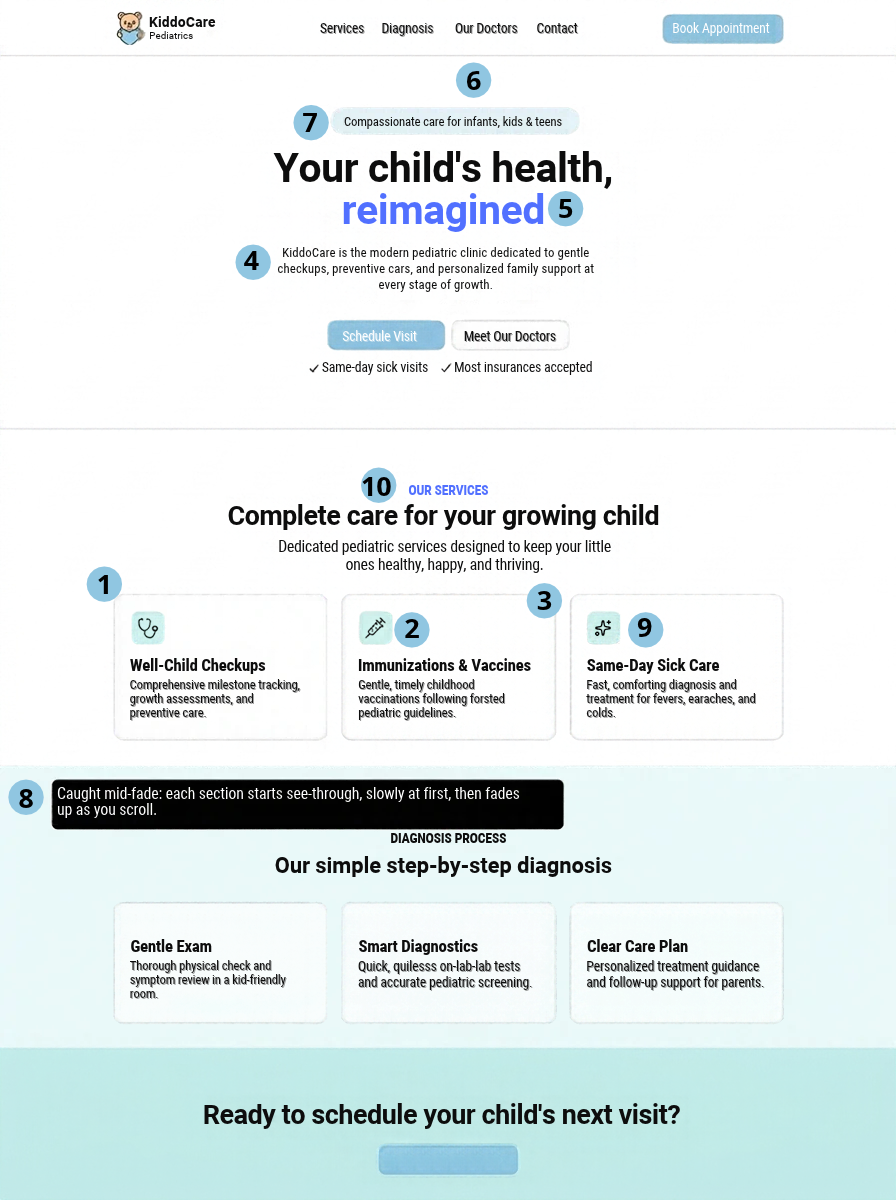
These ten patterns come from a Build to Launch study of 120 AI-built pages. This is a fictional example made with AI to illustrate how “AI Slop” looks and how common those design clichés are.
- Icon cards in a 3- or 4-column grid (63%): services shown as identical rounded cards in a row, so nothing stands out as more important than anything else.
- One icon set only (63%): every icon comes from the same default library (Lucide in the example), so the site shares its visual language with thousands of others.
- Default component colors (61%): the site keeps the template’s color structure (shadcn in the example) and swaps only the main button color.
- No font chosen, or Inter (60%): the typography is whatever the tool picked, not a decision about your brand.
- An accent word in the headline (52%): one word set in a different color (“reimagined” in the example) to add emphasis.
- Centered hero (51%): the headline, subtext, and buttons stacked in the middle, just like everyone else’s homepage.
- A pill badge above the headline (51%): a small rounded tag with a tagline (“Compassionate care for infants, kids & teens” in the example).
- Fade-up on scroll (51%): every section starts see-through and slightly low, then fades in as you scroll, which delays the information the visitor came for.
- “AI” icons: sparkles, zap, brain (47%): symbols that say “technology” instead of anything about the service.
- Small uppercase tracked labels (42%): tiny, widely spaced caps above section titles (“OUR SERVICES” in the example).
Recognize a few of these symptoms? Our design team can review your current layout and put together a custom treatment plan built around your practice, your providers, and the Austin community you serve:
AI Builds Fast. Human Designers Build Patient Trust
Every practice has its own bedside manner, and your website should reflect it. AI generators stack pre-made blocks based on statistical averages. Our designers make deliberate visual and structural decisions that match your brand’s personality and separate you from every other clinic along MoPac and I-35.
Each project depends on our clients’ goals and our specialists’ judgment, so we can’t list every creative decision behind a build. Still, here’s how human-led web design moves beyond “AI Slop”:
Your Real Team, Front and Center
AI templates come with small, generic frames designed for polished stock photos. We reverse that process and design the layout around your real assets. Photos of your actual lobby, your exam rooms, and the staff who greet patients at check-in become the visual anchor of your hero section and navigation. When patients recognize your clinic from your homepage, they walk in already trusting you.
Watch our 1-minute video: A Website’s Key Elements.
Designed for How Austin Patients Live
A generic AI prompt has no idea what it’s like to sit in I-35 traffic or find a specialist in a city where, according to the U.S. Census Bureau, 30.3% of residents speak a language other than English at home. Human designers turn those local details into practical features:
- Clear language toggles in the top navigation bar, not hidden in the footer.
- Location modules that clearly separate your Downtown, Round Rock, Cedar Park, or South Austin offices, with parking guidance for busy areas around downtown and The Domain.
- High-visibility header banners for seasonal updates, like allergy appointment reminders before cedar fever season, which the Austin American-Statesman notes runs from December through mid-February with a peak in January.

Built to Convert, Engineered for HIPAA
AI can produce an attractive contact form, but it doesn’t understand patient friction or healthcare compliance. Before any site launches, our specialists review the technical design from start to finish. We simplify mobile navigation so a parent searching at 10 p.m. can book an appointment with one thumb, confirm the medical content has your physicians’ approval, and build custom intake forms and analytics that protect patient privacy, following HHS guidance on tracking technologies and Protected Health Information (PHI).

4 Tips for the Best Website Design for Medical Practices
Nowadays, one of the most decisive factors for any medical practice to have is a modern, optimized website, as it works both as an introduction for new patients and as a way for your loyal patient base can have access to information and other benefits, like a portal....

Website Design for Medical Practices in San Antonio: A Second Opinion on AI-Built Sites
Website design for medical practices in San Antonio got a lot easier the day AI tools learned to build a homepage in minutes. It also got a lot more crowded (Hooray!). Scroll through enough clinic sites in Bexar County, and you’ll notice they’re starting to look kind...
FAQ
Can I just learn how to build an AI website for my practice myself?
No. Google says appropriate AI use fits within its guidelines, and its systems reward content that is helpful, original, and trustworthy. A site with a human touch gives both Google and your patients more reasons to trust you.
Does Google penalize websites designed with AI?
No. Google says appropriate AI use fits within its guidelines, and its systems reward content that is helpful, original, and trustworthy. A site with a human touch gives both Google and your patients more reasons to trust you.
Should my Austin practice website have a Spanish version?
In most cases, yes. About 30% of Austin residents speak a language other than English at home, so a visible language toggle can make it easier for more patients to find and book with you.
Talk to the Experts in Website Design for Medical Practices in Austin
The right medical website design gives prospective patients a modern, practical platform where they can find what they need and book appointments easily. If you want a stronger online presence heading into 2027, a healthcare marketing agency like White Coat Web can be your best ally. Austin medical practices looking for HIPAA-compliant, high-converting websites can schedule a consultation with White Coat Web.
Contact White Coat Web by calling at (210)-618-0921 or let us know in more detail about your request by filling out this online form and we’ll get in touch with you as soon as possible.

Willie White Coat, AKA Graham Dunlap
Graham is a digital strategist with 10+ years of experience leading marketing teams. As the co-founder of White Coat Web, he focuses on modern SEO/GEO and digital growth, helping medical practices expand their online visibility and revenue while adapting to continuously evolving industry techniques.
In his words, “We’re passionate about people, so you can be passionate about your patients.”