

Dallas-Fort Worth has some of the strongest healthcare brands in the country just a few miles from your practice’s door. And although your clinical care may be better than all of them, patients won’t call you if your website is on page 14 of Google’s results or is hard to navigate. The good news is that you don’t need a hospital’s budget to win. In this post, we’ll break down what actually makes a healthcare website design work for Dallas practices: how patients search, what makes them pick up the phone, how to stay compliant with HIPAA, and the common mistakes that quietly cost practices dozens of new patients every month.
Patient-Centered Healthcare Website Design Puts Your Dallas Practice on the Map
Medical practices in Dallas-Fort Worth compete for attention in one of the most crowded healthcare markets in the country, where large hospital systems with massive advertising budgets sit alongside urgent care clinics, new specialty practices, and aesthetic providers opening in nearly every suburb.
Patients here search from their phones and choose based on whether a practice looks trustworthy, shows up in “near me” results, and makes it easy to book. Meanwhile, practices must navigate HIPAA, Texas advertising rules, and accessibility requirements, all while serving a diverse population that may search in Spanish or expect culturally relevant messaging.
Top healthcare website design addresses these challenges directly:
- It loads quickly on mobile.
- Puts the phone number and online scheduling front and center.
- Highlights provider credentials and patient reviews.
- Uses local content to rank in the neighborhoods the practice actually serves.
- And is optimized to appear first on Google’s search results and be recommended by AI engines.
It also builds in compliant forms, accessible design, and clear information about services and insurance. The result is a site that turns a quick search into a booked appointment, giving independent practices a real way to compete with the big systems down the road.
📺 Watch our 1-minute video: A Website’s Key Elements
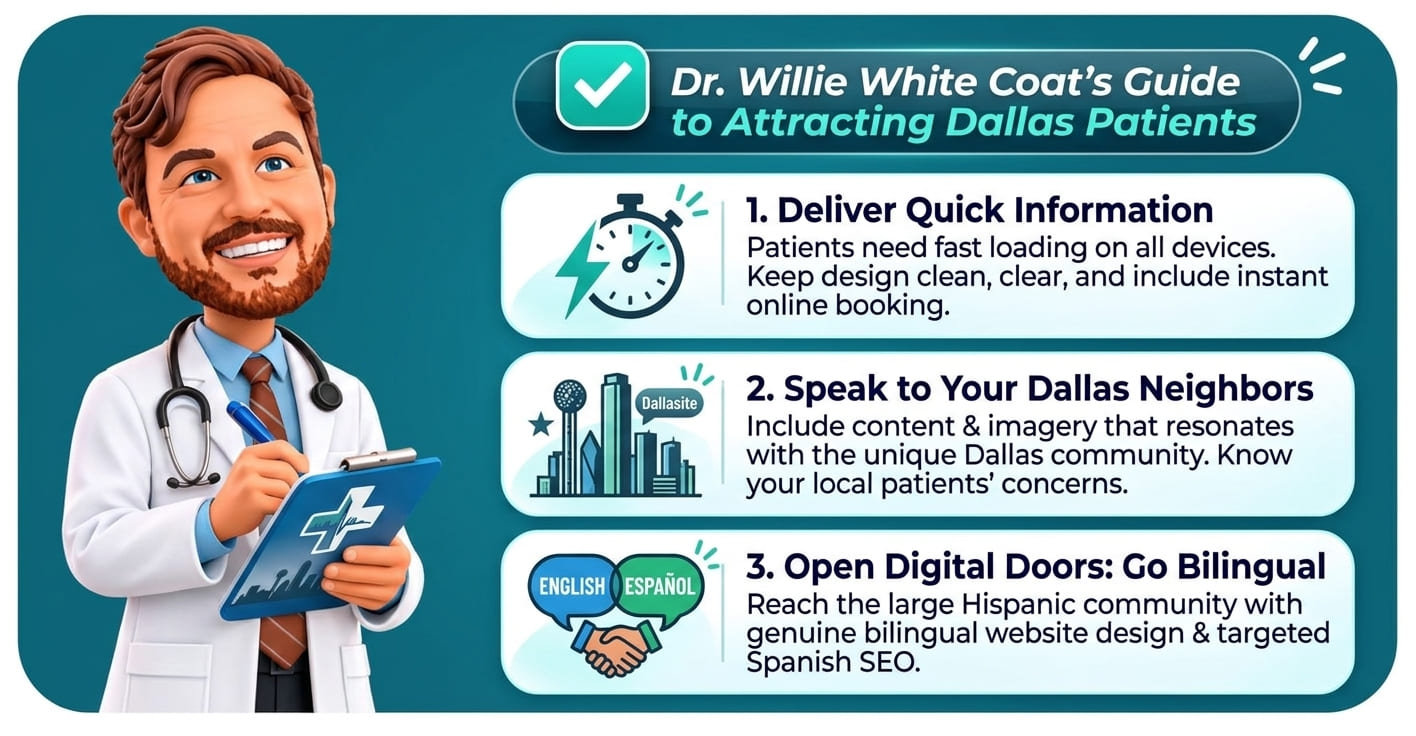
3 Keys to Attract Dallas Patients through Your Website
Speed
When patients are actively looking for a doctor, time is rarely on their side. Either they have had an accident, can no longer put up with chronic pain, or they have received a frightening diagnosis. Your practice’s website needs to not only be among the first results, but also tell them exactly what they need to know about you in microseconds and help them contact you right away.
At the same time, search engines take into consideration how fast your site loads (both on desktop and mobile) to suggest it to patients.
For your practice’s site to convert fast, it should:
- Have a clean design that allows patients to navigate it quickly.
- Feature clear, non-jargony text.
- Include instant online booking features.
📌 Featured Posts

4 Tips for the Best Website Design for Medical Practices
Nowadays, one of the most decisive factors for any medical practice to have is a modern, optimized website, as it works both as an introduction for new patients and as a way for your loyal patient base can have access to information and other benefits, like a portal....

Website Design for Medical Practices in San Antonio: A Second Opinion on AI-Built Sites
Website design for medical practices in San Antonio got a lot easier the day AI tools learned to build a homepage in minutes. It also got a lot more crowded (Hooray!). Scroll through enough clinic sites in Bexar County, and you’ll notice they’re starting to look kind...
Healthcare Website Design that Focuses on Your Community
What makes a Dallasite? Among many things, they know to add 10 minutes to their drive because of traffic and avoid 635 as much as possible. But the truth is that you know your neighbors and patients better than anybody. You know what the most common ailments are, what questions your patients ask most, and how to address them. Let it show.
In order for Google and AI search engines to show your website to prospective patients, your website should include content and imagery that speaks directly to the Dallasite.
☝ Going bilingual does not necessarily mean “translating”. Oftentimes, translating a term does not land with the intended audience because, well, they just don’t use that word for the same thing. When going bilingual, you’ll need to implement specific Spanish SEO techniques. This means researching keywords that are realistically used by Hispanic users in your area. It’s not just simple automatic translations of your original English keywords; you’ll need to get into the shoes of your target audience when it comes to using a search engine.
FAQ
What makes healthcare website design different from other industries?
Healthcare websites must balance patient-friendly design with strict regulatory requirements (HIPAA, ADA, GDPR where applicable). They also need to build trust quickly, accommodate anxious or elderly users, and integrate with practice management and scheduling systems.
Does my healthcare website design need to be HIPAA compliant?
Yes, if your site collects, transmits, or stores protected health information (PHI)—including appointment request forms, contact forms asking about symptoms, or patient portals. White Coat Web ensures your website is compliant so you can rest easy.
What accessibility standards should a healthcare website design follow?
Aim for WCAG 2.1 AA compliance: sufficient color contrast, alt text for images, keyboard navigation, screen-reader compatibility, resizable text, and captions for video content.
Ready to Turn Dallas Searches into Booked Appointments?
Your patients are searching right now, and the practice that is easiest to find, trust, and book gets the call. At White Coat Web, we design and build fast healthcare websites that you own, are ready for Google and AI search, and compliant with HIPAA. We’ll make sure your online front desk is ready for the new patients who come through your doors. Let’s make sure your website is working as hard as your care team does.

Willie White Coat, AKA Graham Dunlap
Graham is a digital strategist with 10+ years of experience leading marketing teams. As the co-founder of White Coat Web, he focuses on modern SEO/GEO and digital growth, helping medical practices expand their online visibility and revenue while adapting to continuously evolving industry techniques.
In his words, “We’re passionate about people, so you can be passionate about your patients.”