

As a healthcare provider, you go above and beyond for your patients; and, naturally, that passion extends to reaching and helping them online. But while your clinical expertise is second to none, translating that knowledge into articles that rank in Google or get cited by AI engines is a discipline all its own. The science of growing your internet presence as a physician is called Search Engine Optimization (SEO). At White Coat Web, we believe in empowering practice leaders like you, so we have created this simple 5-step guide to help you write high-ranking, AI-friendly content for your practice.
How to Write Medical Content that Ranks and AI Cites
You know your patients and you know what you can do for them. Translating that authority into online presence and visibility takes a new skill that is one step up from just writing about it. To bridge the gap between your expertise and eagerness to share it and the search bar, here is White Coat Web’s 5-step framework to writing so that your content ranks high on Google, earns AI citations, and connects with patients who need you most.
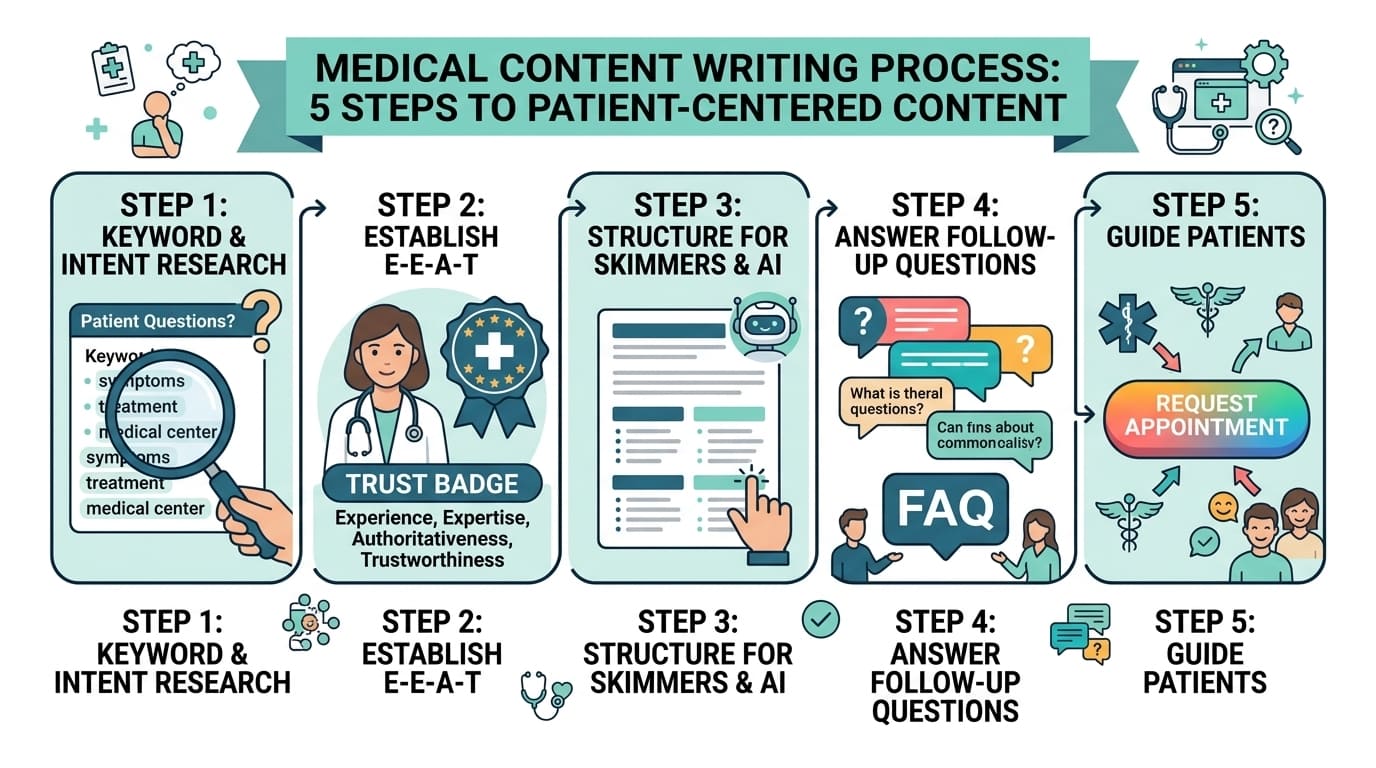
What to Write About? Keyword Research & Intent
You might have an exciting new service launching or a state-of-the-art device arriving at your practice. Naturally, you will want to announce it and talk about it in detail. However, to actually reach patients online, we encourage you to think like one. Patients don’t search like doctors: an individual experiencing knee pain isn’t typing “patellofemoral pain syndrome treatments.” They are most likely looking up “why does my knee hurt when I walk down the stairs?” or “best knee pain doctor near me.”
How to think like a patient?
This is where keywords come in. A keyword is simply any word or phrase a patient types into a search engine when looking for answers, care, or a medical provider. Keyword research is the process of discovering those exact terms so you can build your content around them instead of guessing. You can start doing research by taking your core service and using free tools like Google’s autocomplete bar, AnswerThePublic, or Google Keyword Planner to see the actual phrases people pair with your specialty.

There lies your answer; this will be what your piece will revolve around.
A quick way to do this is to Google the keywords and see what content is performing well (aka ranking first). Ta-dah, there you have it. Think of something along those lines—but better.
🥼 Inspired? Read more: How Medical SEO Connects With Your Patients: Your Online Front Desk
Featured Posts

4 Tips for the Best Website Design for Medical Practices
Nowadays, one of the most decisive factors for any medical practice to have is a modern, optimized website, as it works both as an introduction for new patients and as a way for your loyal patient base can have access to information and other benefits, like a portal....

Website Design for Medical Practices in San Antonio: A Second Opinion on AI-Built Sites
Website design for medical practices in San Antonio got a lot easier the day AI tools learned to build a homepage in minutes. It also got a lot more crowded (Hooray!). Scroll through enough clinic sites in Bexar County, and you’ll notice they’re starting to look kind...
Establish E-E-A-T
Establishing E-E-A-T (Experience, Expertise, Authoritativeness, and Trustworthiness) is key when it comes to medical content. Search engines like Google categorize health and medical information as “Your Money or Your Life” (YMYL) content, meaning it is held to the highest possible standard because poor advice can directly impact a reader’s physical well-being.
As a result, you must prove your authority by following certain guidelines:
- Include a detailed author bio that highlights your medical credentials, board certifications, and years of expertise. Also provide links to sites where patients can check your achievements and certifications.
- Cite authoritative third parties when making statements about clinical results such as peer-reviewed journals, university studies, or recognized health organizations like the CDC. You can add a brief bibliography section at the end or organically place the links to the sources throughout the content.
- Include testimonials and case studies of real patients of the practice. Be careful not to share sensible data that may breach HIPAA standards.
- Tell search engines where your content falls within your site by adding internal links. Internal links to your own related service pages, provider profiles, or complimentary blog posts keep patients engaged on your website longer while helping search engines map out your practice’s medical expertise.
🥼 Want to become an authority in your medical field? Here’s a 3-minute webisode on how to do it: What does it mean to be an “Authority Machine”?
Structure for Skimmers and AI Summaries
Writing with the intention to grow your internet presence as a physician differs from writing for a medical journal or a paper. However, they share some core principals when it comes to clarity.
Although serving different audiences, both need to present clear visual hierarchies to guide the reader, whether that’s a human or a site crawler that classifies your content. Medical papers use standard sections (Abstract, Methodology, Results, etc), while SEO content uses structured headings (H1, H2, H3), concise summaries, and digestible sections to help navigate the information correctly.
Another strategy that helps bots recognize and digest your piece is using bullet points, bolding key terms, and keeping paragraphs short to maintain patient bounce rates low.
Add a FAQ Section
You know your patients and their most pressing and repeated questions. An FAQ section helps both your patients and your website. By pairing clear questions with concise, 1–2 sentence answers, you make your content easily scannable for readers while providing AI engines like ChatGPT and Google Gemini with ideal snippets to quote your practice.
When paired with FAQ Schema markup, these sections can also trigger expandable search snippets directly on Google, giving your practice more visual real estate on the results page and capturing high-intent voice searches.
Call to Action
Every piece of patient-centered content should end with a clear, low-friction Call to Action (CTA) that guides readers seamlessly from education to care. Once you’ve built trust by answering their health questions, don’t leave them wondering what to do next. Use active, value-focused phrases like “Schedule Your Consultation” or “Speak with a Specialist,” paired with prominent scheduling links or click-to-call buttons.
By removing guesswork and providing an immediate next step, you convert informed readers into actual patients actively booking visits with your practice.
FAQ
What is physician online marketing?
Physician online marketing is the strategic use of digital channels—such as SEO-optimized websites, local search listings, social media, online reviews, and targeted ads—to help healthcare providers increase their visibility, build patient trust, and attract new appointments online.
How can physicians grow an online presence?
Physicians can expand their digital presence by maintaining an optimized website with patient-friendly educational content, claiming and updating their Google Business Profile, actively managing patient reviews, and ensuring their practice details are consistent across online medical directories.
Do I need a digital marketing strategy as a doctor?
Yes. Today’s patients research symptoms and compare healthcare providers online long before booking an appointment. A dedicated digital marketing strategy ensures prospective patients find your practice first, trust your clinical authority, and can easily schedule care.
Ready to Grow Your Medical Practice’s Online Presence?
At White Coat Web, we are passionate about helping doctors reach and care for more patients. We encourage you to put these strategies into practice and take control of your online presence. But if managing content strategy on top of clinical care ever feels overwhelming, we completely understand. You went to medical school to practice medicine, and we went into digital marketing to do this. When you are ready to offload the heavy lifting, reach out to our team—we will handle the strategy so you can stay focused on what matters most: your patients.

Willie White Coat, AKA Graham Dunlap
Graham is a digital strategist with 10+ years of experience leading marketing teams. As the co-founder of White Coat Web, he focuses on modern SEO/GEO and digital growth, helping medical practices expand their online visibility and revenue while adapting to continuously evolving industry techniques.
In his words, “We’re passionate about people, so you can be passionate about your patients.”