

New York is one of the most competitive healthcare markets in the world. Thousands of medical practices, hospitals, and specialists compete for the same patients, the same search rankings, and the same trust. Yes, you’re in legend mode when facing this kind of market. Now, even in those circumstances, some practices decide to lean entirely on AI to produce their content marketing without noticing that it is quietly dismantling the very foundation that makes healthcare content credible, visible, and effective. Let’s talk about it.
Healthcare Content Marketing Lives in YMYL Territory
Before debunking all those horrible hooks from AI bros about how marketing teams are going to lose their jobs, let us help you understand the category of content that healthcare practices produce.
Google classifies medical, legal, and financial content under a category called YMYL, short for Your Money or Your Life. Yes, we are not making this up; it is the official term Google uses to describe content that can directly affect a person’s life, which includes:
- Health and medical information: diseases, conditions, treatments, procedures, drugs, and devices that could significantly influence a patient’s decisions or outcomes.
- Safety information: content that, if inaccurate, puts people at real risk of harm.
- Civic and legal information: content that shapes how people understand their rights and responsibilities.
- Information about groups of people: content that, if misleading, can cause discrimination or serious misunderstanding.
As Uncle Ben said, “With great power comes great responsibility.” At the moment you share healthcare content, you’re already walking on thin ice if you don’t know what you’re doing.
A restaurant can claim it serves the best pasta in Manhattan and face little consequence if that turns out to be debatable. On the other hand, if a medical practice publishes inaccurate treatment information faces a different reality entirely:
- Damaged credibility
- Potential legal exposure
- Patients who find more trustworthy information somewhere else
Artificial intelligence tools are useful; that’s undeniable. They can generate text quickly, structure an article, and even reference publicly available medical information. But speed and structure often come at the price of accuracy, context, or clinical responsibility.
Understanding EEAT and Why It Matters
When putting together a healthcare marketing strategy, you must be clear that you are competing in a league with higher standards. This applies to all content platforms (Meta,Instagram, TikTok, and YouTube), but especially to Google. Fortunately, we already know how it prefers this type of content: the EEAT format
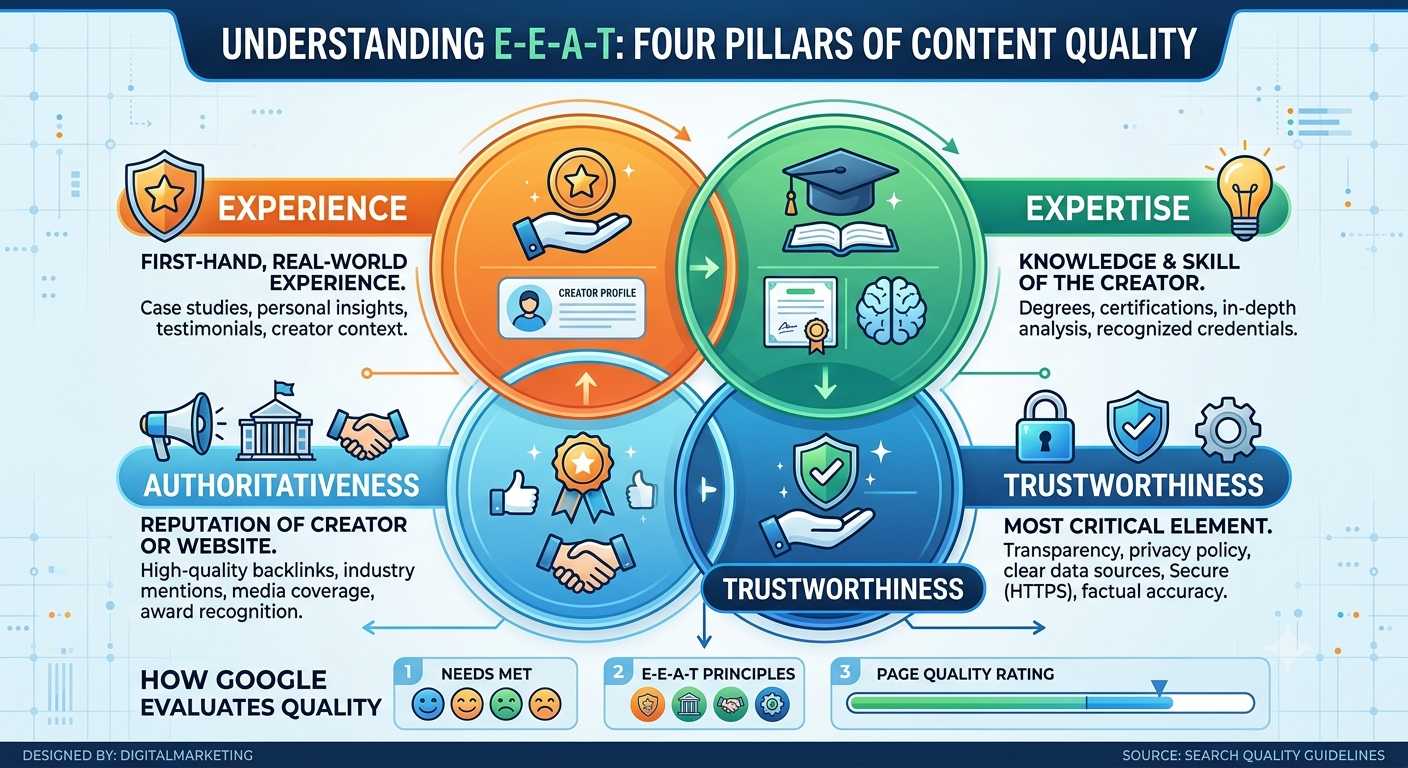
Google’s EEAT (which stands for: Experience, Expertise, Authority, and Trustworthiness) is a framework used by human reviewers to assess content quality. While EEAT is not a confirmed direct factor in SEO’s ranking formula, improving your EEAT is a proven way to help you align with Google’s definition of a good search result.
Here’s a more detailed look at what EEAT means:
- Experience: The first-hand experience the content creator has with the topic.
- Expertise: The content creator’s knowledge and qualifications related to the topic.
- Authoritativeness: The website’s reputability.
- Trustworthiness: The extent to which the content/website is transparent, accurate, uses credible sources, etc.
Why AI Fails EEAT Standards
AI Cannot Carry Medical Credentials or Clinical Accountability
Every piece of healthcare content should be tied to someone with verifiable qualifications. A blog post about managing Type 2 diabetes in New York carries far more weight when it is authored or reviewed by a board-certified endocrinologist whose credentials and biography are clearly displayed. AI cannot provide that attribution.
The only way this works is if the specialist handles the AI copy-pasting themselves and thoroughly reviews the entire document. From our experience, mistakes and hallucinations are the order of the day when working with AI; the effort and attention to detail required to make the content truly reliable is almost equal to that of a doctor writing the article from scratch.
AI Misses the Local Nuances That Matter in New York
At this point, New York and diversity are almost the same word. A dermatology practice in Midtown serves a different patient demographic than one in Flushing or the Bronx. Community-specific concerns, languages spoken, insurance coverage patterns, and even the way patients describe their symptoms vary across the city.
Sometimes, even we have problems understanding these distinctions, and need more conversations with our clients to really understand the audience. AI produces generalized content that resonates with no one in particular, and for some weird reason it sounds forced to everyone.
Unreviewed AI Content Creates Real Compliance Risk
Healthcare content in the United States operates under a regulatory environment that includes HIPAA guidelines, FTC advertising standards, and platform-specific policies from channels like Instagram, YouTube, and TikTok. AI tools are not designed to navigate these requirements, and they will not flag when a generated piece of content makes a claim that crosses a regulatory line. A human team familiar with healthcare marketing compliance will catch these issues before they become a problem. An AI workflow without expert review will not.
FAQ
What is content marketing for healthcare practices in New York?
It is the process of creating and distributing accurate, educational, and locally relevant content to attract patients, build credibility, and improve a practice’s visibility in one of the most competitive healthcare markets in the country.
Can a medical practice in New York use AI to create content?
AI can assist with research and initial drafting, but every piece must be reviewed and approved by qualified people before publication. Unreviewed AI content in a YMYL context carries real reputational, regulatory, and ranking risks.
Why does healthcare content require a different marketing approach?
Healthcare content falls under Google’s YMYL classification because it can directly influence patient decisions and health outcomes. That classification raises the bar for accuracy, source credibility, and the professional review process behind every published piece.
What is EEAT, and why does it matter for New York healthcare practices?
EEAT stands for Experience, Expertise, Authority, and Trustworthiness. It is the framework Google uses to assess whether healthcare content meets the standards required to perform well in search. Practices that consistently align with EEAT principles build stronger organic visibility over time.
How often should a medical practice in New York publish content?
Consistency is more important than volume. Publishing two to four well-researched, clinically reviewed articles per month produces stronger long-term results than a high volume of superficial content that lacks professional oversight.
How long does it take to see results from healthcare content marketing in New York?
Most practices begin to see measurable organic growth within three to six months of consistent, quality publishing. Authority and trust signals accumulate over time, which means the strategy becomes progressively more effective the longer it runs.
Does EEAT apply to social media content as well?
Yes. The same standards apply to content published on Instagram, YouTube, TikTok, and other platforms. Healthcare content across all channels should be accurate, tied to a credible professional voice, and free of misleading claims that could affect patient decisions.
Build a Healthcare Content Marketing Strategy in New York That Works
Competing for patients and visibility in New York requires more than a content calendar and an AI tool. It requires a team that understands the clinical context behind every claim, the regulatory environment around healthcare advertising, and the local nuances that make one practice relevant to the community it serves.
White Coat Web works exclusively with healthcare practices and providers to build content marketing strategies that meet the EEAT standards Google expects and earn the trust that patients deserve. Contact White Coat Web today and let us build an approach that supports your practice’s growth in New York.